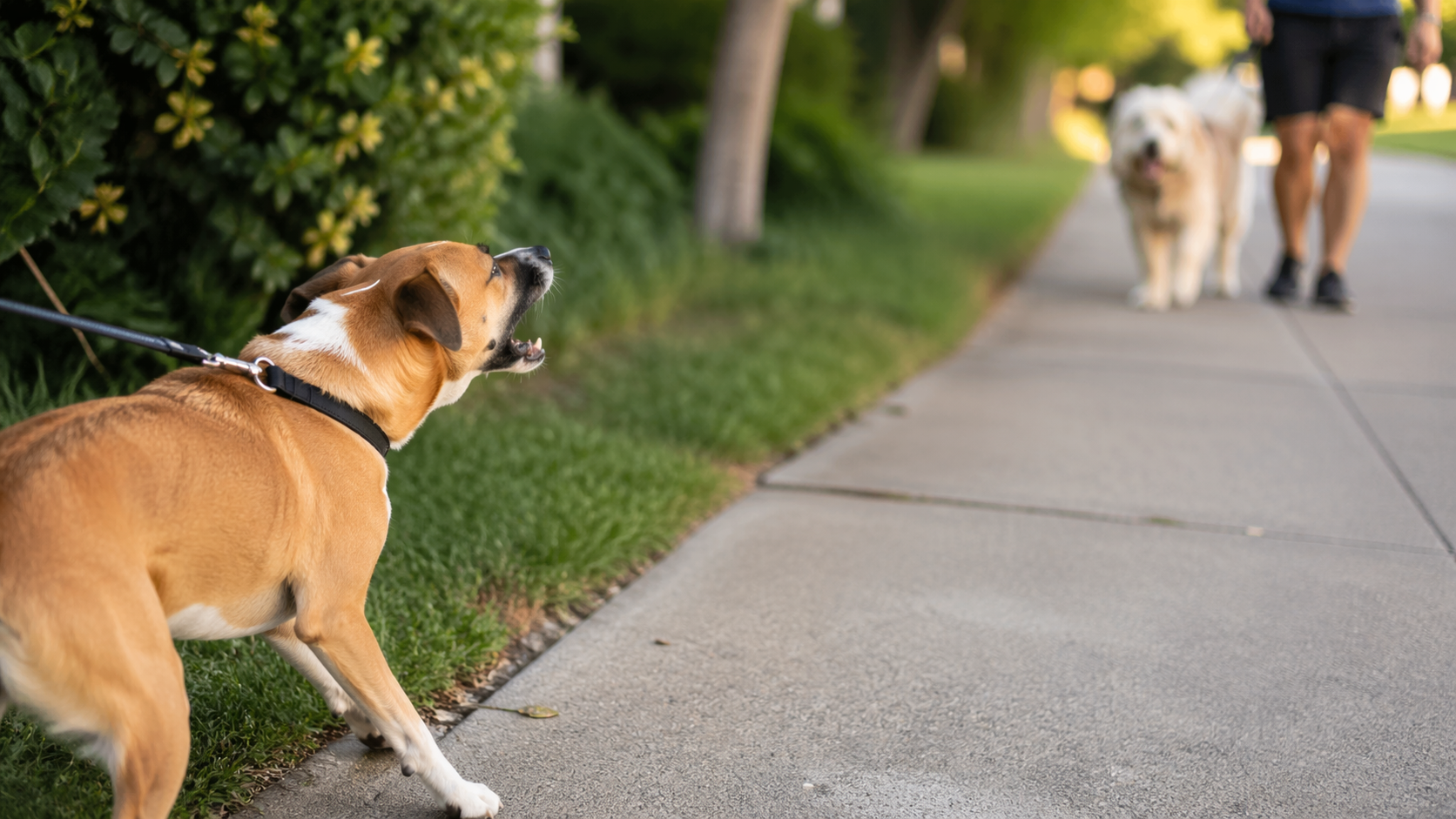
You’re walking. Leash is loose. Your dog is fine—until another dog appears.
Then it happens fast: staring, stiffening, barking, lunging.
If you’re dealing with dog barking at other dogs on walks, you’re not dealing with “bad behavior.” You’re stepping into a very specific reaction chain that starts seconds before the explosion.
This kind of reaction is very different from what happens inside your home. If your dog shows stronger behavior when people enter your space, that usually points to territorial behavior toward visitors, not leash reactivity.
Right now, you’re reacting too late.
I’m going to stand beside you and show you exactly where you’re missing it—and how to take control before it blows up.
What You Think vs What’s Actually Happening
You think: Your dog suddenly reacts when it sees another dog.
What’s actually happening: The reaction starts 3–5 seconds earlier—quietly—and you’re missing the first signal.
Why the confusion exists: Barking is loud. The early signals are silent.
First visible signal: Eye lock + mouth closes.
Control moment: The instant your dog notices the other dog—but before tension hits the leash.
AHA Insight: The bark isn’t the problem—the stare is.
Behavior Chain — Watch This in Slow Motion
Let’s slow this down like I’m watching your dog in real time.
Stimulus: Another dog appears 10–20 meters ahead.
Eyes: Your dog’s head lifts slightly. Eyes lock. Blinking stops.
Ears: Rotate forward. Not loose—focused.
Mouth: Closes. Panting stops instantly.
Micro-freeze: A half-second pause. Subtle—but critical.
Tension shift:
Weight shifts forward.
Front legs stiffen.
Leash starts to tighten—even slightly.
Breathing changes: Shorter, sharper breaths.
Decision point: Your dog is now evaluating:
→ “Do I engage?”
→ “Do I escalate?”
If nothing interrupts here:
→ Body leans forward
→ Tail stiffens (not wagging loosely)
→ First vocalization (low whine or sharp bark)
Explosion:
→ Barking
→ Lunging
→ Full leash tension
Reinforcement:
→ Other dog moves away OR you pull back
→ Your dog learns: “That worked.”
This entire chain happens in under 5 seconds.
You’re stepping in at second 5.
We need you at second 1.
Why This Is NOT “Just Excitement”
This is where most owners misread the situation.
You might think:
“My dog just wants to say hi.”
But here’s the difference.
Excited social dog:
- Loose body
- Wiggly movement
- Soft eyes
- Curved approach
- Can disengage easily
Reactive barking dog on leash:
- Stiff posture
- Direct eye lock
- Forward weight shift
- Stops responding to you
- Escalates quickly
The environment matters.
On leash, your dog:
- Can’t approach naturally
- Feels restricted
- Builds pressure instead of releasing it
Strong contrast statement:
This is not social behavior being blocked.
This is pressure building with no outlet.
That’s why it explodes.
How to Stop This BEFORE It Starts
This is the most important part.
Everything depends on a 1–5 second window.
First signal you must catch:
- Head lifts
- Eyes lock
- Mouth closes
This happens BEFORE barking. BEFORE lunging.
Your timing window:
→ 1 to 2 seconds after eye lock
If you act here, your dog is still thinking.
If you wait longer, your dog is reacting.
If you miss this moment, stopping the behavior becomes significantly harder.
Once the leash tightens:
- Adrenaline spikes
- Hearing drops (your dog ignores you)
- Muscles are engaged forward
At that point, you’re managing damage—not training.
So your job is simple—but precise:
Interrupt the stare BEFORE tension hits the leash.
Real-Time Action Script (Do This Exactly)
I’m walking with you now. Another dog appears.
Moment 1 — Your dog notices (head lifts):
→ Within 1 second, say softly: “Yes” or your marker word
→ Do NOT raise your voice
→ Keep your shoulders relaxed
Why: You’re marking awareness—not reaction.
Immediately after:
→ Toss a treat 40–60 cm BEHIND your dog’s back paw
→ Slightly to the left or right (not straight back)
Why: This forces a full head and body turn away from the trigger.
Body position:
→ Stay facing forward
→ Do NOT step toward the other dog
→ Keep leash loose (no pulling)
Distance rule:
If the other dog is within 5–8 meters:
- Take 2–3 slow steps diagonally away (not straight back)
Why: Creates space without triggering chase or tension.
If your dog hesitates and keeps staring:
→ Step slightly into your dog’s line (half step forward)
→ Block the direct view for 1 second
→ Then repeat treat toss behind
Why: You break visual fixation physically, not verbally.
Precision Training Steps (Follow Exactly)
Step 1 — Catch the Eye Lock Early
When: The instant your dog’s head lifts and eyes fix on another dog
Do: Say “Yes” calmly within 1 second
Where: Standing upright, facing forward
How far: No movement yet
What NOT to do: Don’t say your dog’s name repeatedly
Why: Repetition becomes background noise and gets ignored
Micro scenario (5:42 PM, sidewalk):
Your dog spots a dog across the street. Head lifts.
You quietly say “Yes” before tension builds.
Step 2 — Force a Physical Disengagement
When: Immediately after marking
Do: Toss a treat behind your dog
Where: Behind back paws, angled 30° left or right
How far: 40–60 cm
What NOT to do: Don’t lure in front of the dog
Why: Forward luring keeps focus on the trigger
Micro scenario (7:10 AM, narrow path):
Your dog freezes staring ahead.
Treat lands behind. Dog turns fully to get it—connection resets.
Step 3 — Create Space Without Tension
When: As your dog finishes the treat
Do: Take 2–3 diagonal steps away
Where: 45° angle from the approaching dog
How far: About 1–2 meters total
What NOT to do: Don’t pull the leash tight
Why: Tight leash = pressure = faster escalation
Micro scenario (6:25 PM, park edge):
Other dog getting closer. You angle away casually.
Your dog follows without tension.
Step 4 — Re-engage BEFORE the Second Stare
When: Before your dog looks back at the trigger
Do: Drop another treat near your foot
Where: Slightly behind your heel
How far: 20–30 cm
What NOT to do: Don’t wait for barking to restart
Why: Prevents re-fixation loop
Micro scenario (2:18 PM, quiet street):
Dog finishes first treat and begins to glance back.
Second treat interrupts that thought instantly.
Step 5 — Exit Cleanly
When: Once the other dog passes or distance increases
Do: Walk forward calmly
Where: Straight ahead
How far: Resume normal pace after 3–5 steps
What NOT to do: Don’t reward after barking episode
Why: Timing defines what behavior gets reinforced
Micro scenario (8:03 AM, corner turn):
Other dog gone. You move forward calmly.
Your dog resets instead of scanning for more triggers.
Real Case Scenario
Client dog: 2-year-old Border Collie mix
Problem: Barking and lunging at every dog within 15 meters
Mistake:
Owner waited until barking started, then pulled leash tight and said “No”
What dog learned:
→ Other dogs = tension + frustration
Correction:
We shifted focus to early eye-lock interruption using the exact steps above
Timeline:
Day 1: Reduced intensity
Day 5: No lunging, occasional stare
Day 12: Calm pass at 5–6 meters distance
Nothing changed except timing.
Common Mistakes (And What Your Dog Learns)
1. Waiting for barking
→ Too late
→ Dog learns escalation works
2. Pulling the leash tight
→ Adds frustration
→ Dog associates other dogs with pressure
3. Saying the dog’s name repeatedly
→ Becomes noise
→ Dog tunes you out
4. Letting the dog “stare it out”
→ Builds tension
→ Leads to explosive reaction
If your dog also reacts differently to people versus familiar visitors, compare that behavior with dog barking at strangers but not guests—the trigger pattern is similar but context-driven.
If your dog shows similar reactions in other environments, it’s worth understanding the full pattern. You can explore more training scenarios in our dog behavior guides.
Conclusion
Fixing dog barking at other dogs on walks is not about stopping barking.
It’s about intercepting the moment before it begins.
Watch the eyes. Interrupt the stare. Control the first second.
That’s where the outcome changes.