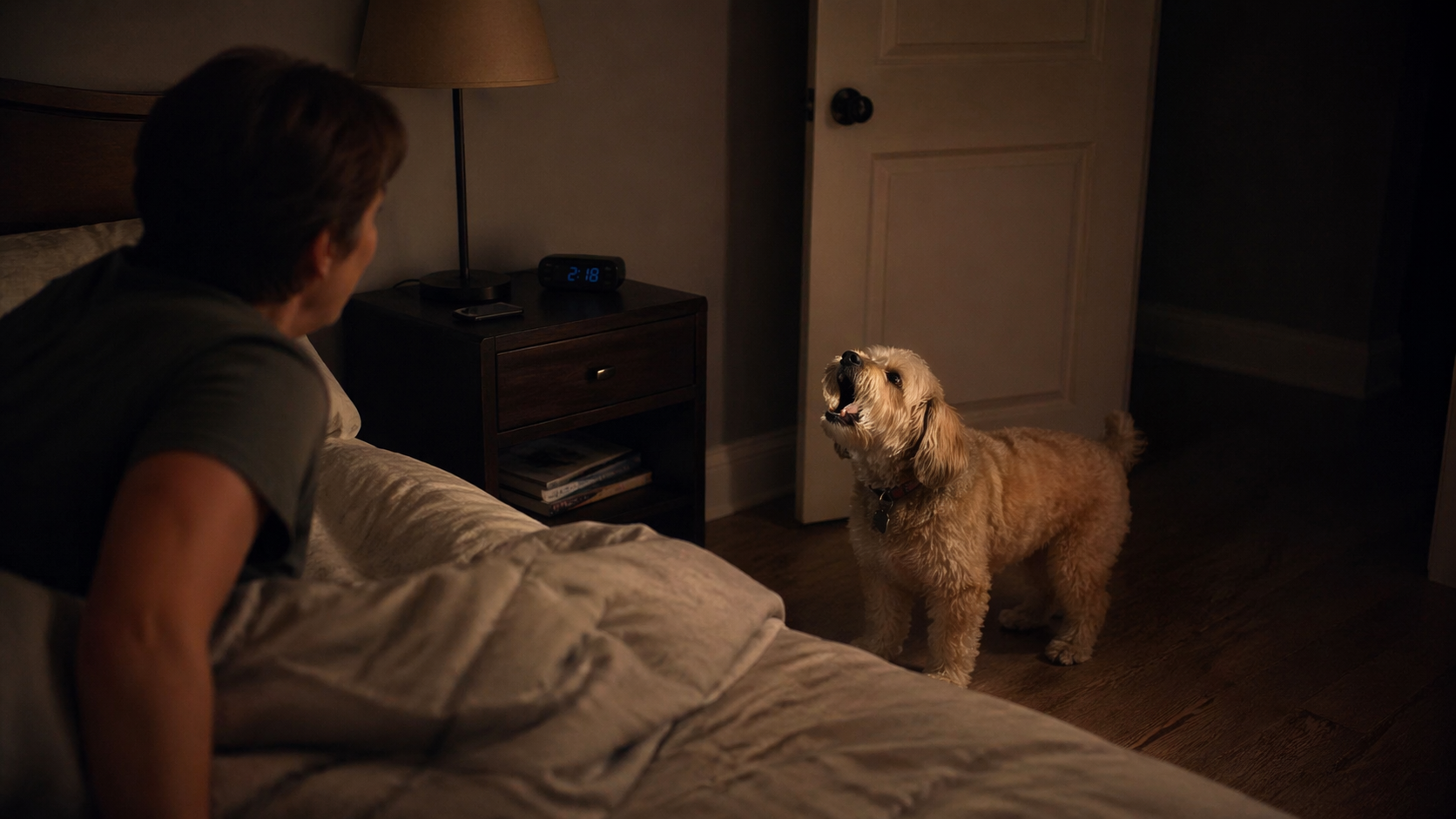
You’re not imagining it. Your older dog barking suddenly at night is not random—and it’s not “just aging.” Right now, I want you to picture last night clearly. The house is quiet. Around 2:18 AM, your dog lifts its head, stares into nothing, and then—sharp, sudden barking. You sit up, confused. There was no noise. No trigger you could see.
But your dog didn’t bark out of nowhere.
What you’re seeing is a delayed reaction to an internal trigger—most commonly cognitive decline, sensory distortion, or disorientation. The mistake? You’re reacting to the bark. The real moment happened seconds earlier.
We’re going to catch that moment—and control it.
Important shift: When an older dog suddenly starts barking at night, this is rarely learned behavior. It’s a signal that something has changed—physically, mentally, or in how your dog is perceiving the environment.
What You Think vs What’s Actually Happening
You think: “My older dog is barking randomly at night.”
What’s actually happening: Your dog is experiencing a brief disorientation event—like waking up and not recognizing where they are—and then alerting (barking) to resolve that confusion.
Why the confusion exists: The trigger is internal, not external. You don’t hear or see it—but your dog feels it.
First visible signal: A sudden head lift with stiff neck and unfocused eyes.
Control moment: The 1–3 second window right after the head lift—before the first bark.
Why This Is Different From Normal Night Barking
Younger dogs: Barking at night is usually tied to a clear trigger—noise, alert behavior, or habit.
Older dogs: Sudden barking at night often has no clear external trigger. It appears unpredictable because the cause is internal.
- Not just reacting → misinterpreting
- Not just alerting → becoming disoriented
- Not just hearing something → filling in missing sensory information
This is the key difference:
Normal barking responds to something real.
Sudden barking in older dogs often responds to something perceived.
Behavior Chain — Frame by Frame (Slow Motion)
Let’s slow this down exactly as it happens.
Stimulus (internal):
At 2:18 AM, your dog shifts from deep sleep into a semi-awake state. The brain misfires slightly—common in senior dogs. For a split second, they don’t recognize the room.
Ear / Eye Movement:
Ears twitch forward, but not toward a sound—more like scanning. Eyes open wider than normal, but they don’t track movement. You’ll notice a “blank stare,” not focused on a real object.
Micro Freeze:
The body goes still. Completely still. This lasts about 1–2 seconds. No tail movement. No repositioning. Just a freeze.
Tension Shift:
Muscles tighten around the neck and shoulders. The dog slightly raises their head higher than usual sleeping posture. Breathing becomes shallow.
Action:
Sudden bark. Sharp. Loud. Often repeated in 2–4 bursts. The bark isn’t directed at a real target—it’s a “locate and confirm” bark.
Reinforcement:
You react—sit up, speak, move, maybe turn on a light. Your dog now orients to you. Confusion resolves. Brain goes: “Barking helped me reconnect.”
That’s the loop.
Not fear. Not guarding. Not “hearing things.”
It’s confusion → bark → clarity.
AHA Insight: Your dog isn’t barking at something—they’re barking to understand where they are.
Why This Is NOT “Dog Barking at Night for No Reason”
Superficially, it looks identical. Night. Silence. Sudden barking.
But the mechanism is completely different.
In typical dog barking at night for no reason, the trigger is external—even if subtle. A distant sound. Movement. A learned alert pattern. The dog’s body will orient toward something specific: window, door, hallway.
With an older dog barking suddenly at night, there is no orientation.
Here’s the contrast:
- External trigger barking: Dog turns head toward a direction → ears lock → body angles → bark is targeted
- Age-related barking: Dog lifts head upward or straight ahead → eyes unfocused → body stays in place → bark is general, not directed
Environmental difference matters too.
If your dog barks at 2:18 AM and immediately looks at the door—external.
If your dog barks and then looks around like they’re trying to “find reality”—internal.
Strong contrast:
This is not a reaction to the world.
This is a reaction to losing orientation within it.
And if you treat it like normal barking—telling them to stop, reassuring verbally—you reinforce the confusion loop.
How to Stop This BEFORE It Starts
This is the most important part. Forget stopping barking. We prevent the moment that causes it.
First signal:
Head lifts suddenly from sleep—higher than a normal reposition. Neck stiff. Eyes open but not focused.
Your window:
1 to 3 seconds.
If you miss this moment, stopping the behavior becomes significantly harder.
Why? Because once the bark happens, your dog has already committed to resolving confusion through vocalization.
So here’s what you do.
At night, you need to be mentally “on standby” for this specific movement—not the bark.
At 2:18 AM scenario:
You hear subtle movement—fabric shift, nails slightly adjusting on the floor.
You don’t wait.
You look immediately.
If you see:
- Head raised
- Eyes open wide but not tracking
- Still body
That’s your entry point.
You intervene BEFORE sound happens.
Because what your dog needs in that exact moment is orientation—not correction.
Real-Time Action Script (Zero Ambiguity)
WHEN: The instant your dog lifts its head and freezes (before barking)
DO:
Within 1 second, softly say your dog’s name once
WHERE:
From your current position—do NOT move closer yet
HOW FAR:
Stay at least 1–2 meters away initially
WHY:
Your voice anchors them without adding spatial pressure
Immediately after (within 2 seconds):
DO:
Gently tap the mattress or floor 2 times
WHERE:
Beside you—not toward the dog
WHY:
Creates a secondary orientation cue (sound + location)
If dog is still frozen:
DO:
Slowly turn your upper body sideways (not facing directly)
HOW FAR:
Rotate about 45 degrees
WHY:
Reduces perceived pressure while staying visible
Then:
DO:
Toss a small treat 40–60 cm BEHIND your dog
WHY:
Forces them to turn, breaking the freeze and reorienting physically
IMPORTANT: Do NOT toss in front—that keeps them locked forward
If barking already started:
DO:
Do NOT speak immediately
WAIT:
2 seconds for a pause between barks
THEN:
Use the same name cue once
WHY:
Interrupting mid-bark increases intensity
Precision Training Steps (Locked System)
Step 1 — Night Setup Positioning
Before sleep, position your dog’s bed within 1.5–2 meters of you. Not across the room.
What NOT to do: Don’t isolate them in another room—it increases disorientation.
Why: Proximity reduces the intensity of confusion episodes.
Micro scenario: 11:47 PM, lights off. Dog settles. You confirm you can see their silhouette without moving.
Step 2 — Trigger Recognition Drill
During the night, the moment you hear ANY movement, you visually check within 1 second.
What NOT to do: Don’t wait for barking as confirmation.
Why: The bark is too late.
Micro scenario: 2:18 AM, faint collar shift. You open your eyes immediately and spot the head lift.
Step 3 — Soft Anchor Cue
Say the dog’s name once, low tone, no repetition.
Distance: 1–2 meters away
What NOT to do: No “it’s okay,” no multiple words.
Why: Simplicity prevents cognitive overload.
Micro scenario: Dog freezes. You say “Max.” Dog’s ear flicks toward you.
Step 4 — Directional Disengagement
Toss treat behind dog (40–60 cm, slight angle).
What NOT to do: Never toss toward their line of sight.
Why: You’re breaking the forward freeze pattern.
Micro scenario: Treat lands behind left hip. Dog turns head, freeze breaks instantly.
Step 5 — Controlled Re-settle
Once dog moves, remain still. Do not call them over.
What NOT to do: No petting, no excitement.
Why: You want calm resolution, not stimulation.
Micro scenario: Dog circles once, lies back down within 5 seconds.
Step 6 — Pattern Reinforcement
Repeat this exact sequence every night episode for 5–7 days.
Why: The brain starts skipping the bark phase entirely.
Micro scenario: By night 4, dog lifts head, hears name, immediately relaxes—no bark.
Real Case Scenario
12-year-old Shih Tzu. Barking every night at 2–3 AM.
Owner mistake: turning on lights and talking continuously.
Dog learned: barking = environment becomes clear.
Correction: pre-bark interception using name cue + backward treat toss.
Timeline:
- Night 1–2: Bark reduced in duration
- Night 3–4: Bark replaced with head lift + pause
- Night 5+: No barking, just reposition and sleep
Common Mistakes
1. Talking too much
Why it fails: Overstimulates a confused brain
Dog learns: Noise = more confusion
2. Turning on bright lights
Why it fails: Sensory overload
Dog learns: Night = unpredictable environment
3. Calling dog toward you
Why it fails: Adds movement pressure during confusion
Dog learns: Must escalate to respond
4. Ignoring early signals
Why it fails: You lose the control window
Dog learns: Barking is the only reliable reset
If this behavior starts blending into whining or broader nighttime distress, you’ll want to understand the bigger pattern (, , ).
When This Is No Longer a Training Issue
If the barking appears suddenly, increases over time, or is paired with confusion, pacing, or disrupted sleep patterns, training alone may not be enough.
At this stage, the behavior is often linked to underlying changes such as discomfort, sensory decline, or cognitive shifts.
Key rule: If the behavior feels new, persistent, or out of character—don’t just train it. Investigate it.
Sudden behavior changes in older dogs can appear in different forms. To see how other behavior patterns develop and how to respond, visit our dog behavior guides.
Conclusion: Older Dog Barking Suddenly at Night
Your older dog barking suddenly at night is not random—it’s a predictable, interruptible sequence.
You’re not stopping barking.
You’re guiding your dog out of confusion before they feel the need to bark.
Watch the head. Catch the freeze. Intervene within seconds.
That’s the difference between reacting—and leading.