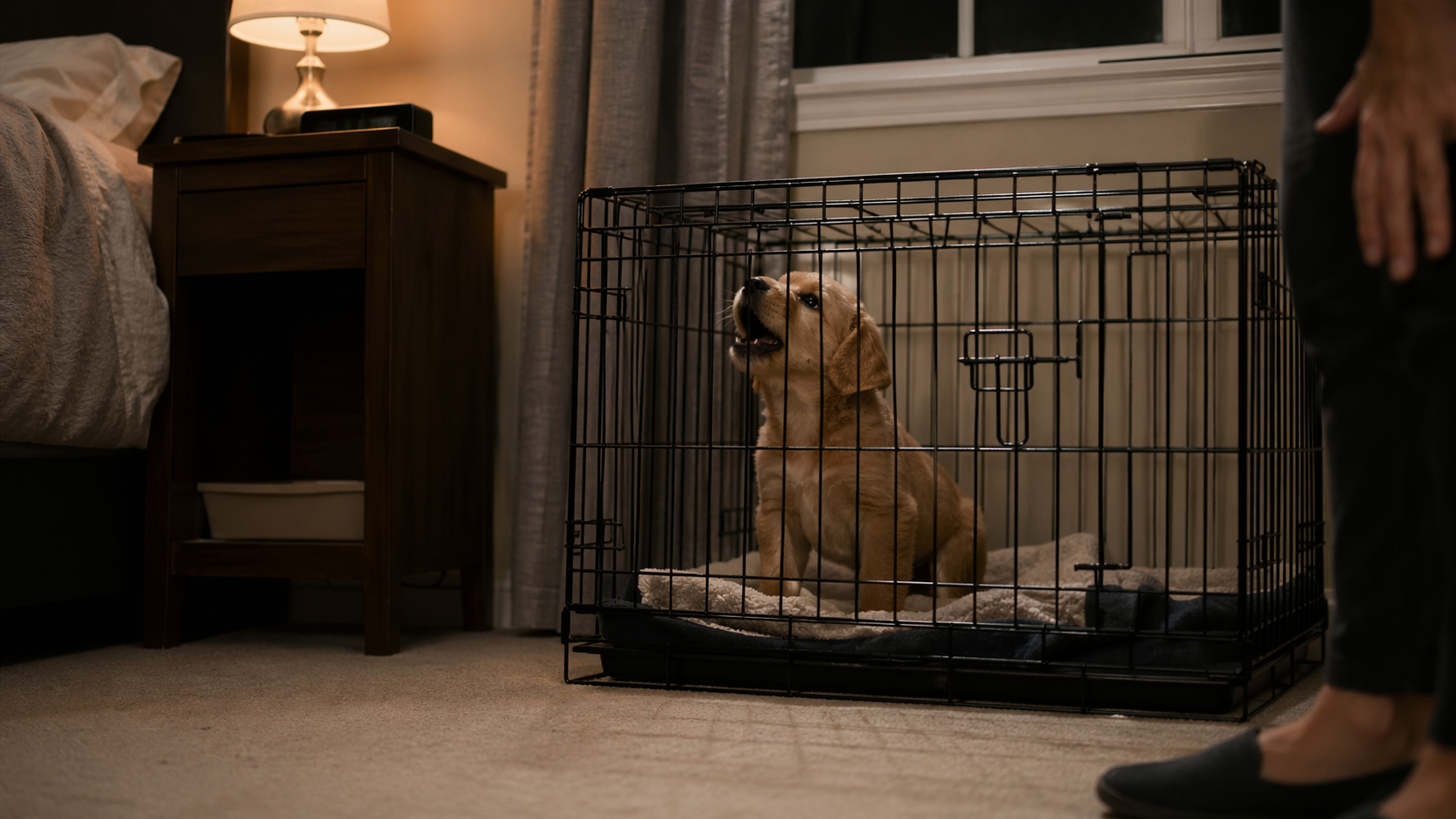
It’s your first week. It’s 2 AM. Your puppy barking in crate at night sounds urgent, sharp, almost desperate. You’re standing there thinking: “They hate the crate… they’re scared… I need to help.”
Pause. Don’t move yet.
What you’re hearing isn’t panic the way you think. It’s a very specific learning loop forming — right now, in seconds.
I’m going to walk you through exactly what’s happening, what you’re missing, and what to do in the next 1–3 seconds that will decide whether this becomes a week-long adjustment… or a month-long problem.
Your puppy isn’t being difficult—it’s a baby suddenly sleeping alone for the first time.
What You Think vs What’s Actually Happening
You think: “My puppy is scared and needs comfort.”
What’s actually happening: Your puppy is testing whether noise controls your movement.
The crate isn’t the problem yet. Your timing is.
Why the confusion? Because barking sounds emotional, but the learning pattern behind it is mechanical and fast.
First visible signal: head lift + ears pivot toward the room.
Control moment: the 1–2 seconds before the first bark.
AHA: The barking isn’t the problem — your response timing is what teaches it to continue.
Behavior Chain (Slow Motion Breakdown)
Let’s slow this down like we’re watching it frame by frame.
2:17 AM. Room is quiet. Puppy has been asleep for 20 minutes.
Stimulus:
Internal shift — lighter sleep phase. Not fear. Just waking.
Ear movement:
One ear flicks toward the door. Then the other. Small, almost invisible.
Eye movement:
Eyes open halfway. No tension yet.
Micro-freeze:
Body stays still — this is assessment mode. “What’s happening? Where is everyone?”
Tension shift:
Neck extends forward slightly. Chest tightens. Breathing changes from slow to alert.
This is your window.
Action (if nothing happens):
Puppy sits up → 1–2 second pause → first vocal test bark.
It’s not loud yet. It’s a probe.
Reinforcement loop begins:
If you:
- talk
- move
- walk toward crate
The puppy logs: “Sound makes human appear.”
Second bark comes faster.
Then whining layers in.
Then full barking sequence.
Escalation pattern:
Bark → pause → listen → bark louder → repeat
Each repetition increases intensity because the puppy is actively searching for the “right volume” that makes you move faster.
This is not distress learning.
This is control learning.
Why This Is NOT Separation Anxiety
This is where most owners get it wrong.
Separation anxiety looks like:
- Immediate panic when alone
- Continuous distress (no pauses)
- Scratching, drooling, frantic movement
This crate barking at night looks like:
- Delayed start (after sleep cycle)
- Pauses between barks
- Listening for response
That pause is everything.
It means your puppy is not overwhelmed.
It means your puppy is thinking.
Environment difference:
Night crate barking = low stimulation, controlled space
Separation anxiety = high internal panic, chaotic movement
Sharp contrast:
One is “Where are you?”
The other is “I can’t cope without you.”
If your puppy pauses to listen, you’re dealing with a behavior loop — not emotional collapse.
For a clearer comparison with true pre-exit distress patterns, see how this differs from dogs that cry when left alone, where the emotional trigger builds before separation even happens.
Not All Barking Means the Same Thing
Before you try to stop the barking, you need to identify what type it is.
- Distress barking: high-pitched, continuous, emotional
- Potty signal: restless movement first, then short bursts
- Demand barking: stops and starts, watching for your reaction
Each one requires a different response. Treating them the same will slow down your progress.
How to Stop This BEFORE It Starts
This is your most important section. Everything depends on this.
Exact first signal:
- Ear flick toward door
- Head lifts 2–5 cm
- Eyes open but body still down
Your window: 1–5 seconds before the first bark.
You must act here — not after the bark.
If you miss this moment, stopping the behavior becomes significantly harder.
What you do:
The goal is not to “comfort.”
The goal is to interrupt the decision to vocalize.
2:18 AM scenario:
You see the head lift.
→ Within 1 second, softly make a low, calm sound (“shhh” or a gentle tongue click)
→ Do NOT move your feet
→ Slightly shift your weight backward (5–10 cm, subtle)
→ Toss a treat 30–50 cm BEHIND the puppy inside the crate
Why this works:
- The sound interrupts the decision loop
- The treat redirects body position backward (away from door focus)
- No forward movement means no “reward for barking” association
If you wait until barking starts:
- you’re reacting
- the puppy is leading
Before barking = you lead
After barking = puppy leads
Real-Time Action Script (Exact Execution)
Moment: Puppy’s head lifts
1. WHEN: within 1 second of head movement
DO: whisper “shhh” once
WHERE: from your current position (no stepping forward)
HOW FAR: zero steps forward, slight lean back only
WHY: interrupts alert escalation without adding stimulation
2. WHEN: immediately after sound
DO: toss one small treat
WHERE: behind puppy’s back legs inside crate
HOW FAR: 30–50 cm from puppy’s nose
WHY: forces disengagement from crate door
3. WHEN: puppy turns head to get treat
DO: stay completely still
WHERE: outside crate, side angle (not directly in front)
HOW FAR: maintain at least 1 step distance
WHY: prevents linking your presence to vocal behavior
4. WHEN: puppy settles again
DO: no praise, no talking
WHERE: remain neutral
WHY: calm resets should feel normal, not rewarded with excitement
Precision Training Steps (Follow Exactly)
Step 1: Positioning Before Night Starts
At 10:30 PM, place crate so the door is angled 30–45 degrees away from your bed.
Stand beside it.
→ Take one step back (roughly 60–80 cm)
→ Sit or lie down where puppy can hear you, not see you directly
Do NOT: place crate directly facing you
Why: direct visual access increases alert scanning at night
Micro-scene (11:02 PM):
Puppy lies down, sees less of you, settles faster
Step 2: Catch the First Wake-Up
2:14 AM
Puppy shifts.
→ Within 1–2 seconds, make a soft interrupt sound
→ Toss treat behind body (40 cm)
Do NOT: wait for barking
Why: you’re shaping silence, not stopping noise
Step 3: Control Your Body Movement
When you respond:
→ Keep shoulders angled slightly away from crate
→ Feet stay planted
→ No leaning toward puppy
Do NOT: crouch, approach, or hover
Why: forward movement = reward signal
Micro-scene (2:31 AM):
Puppy looks up, you stay still → puppy lies back down
Step 4: If Barking Already Started
2:46 AM
Puppy barks twice.
→ Wait for 1-second pause between barks
→ THEN make your soft sound
→ Toss treat behind (50–60 cm)
Do NOT: respond during the bark
Why: you reinforce the pause, not the noise
Step 5: Reset Without Engagement
After puppy settles:
→ No talking
→ No touching crate
→ No eye contact
Do NOT: reward calm with attention
Why: calm must feel neutral, not exciting
Micro-scene (3:05 AM):
Puppy curls up, you do nothing → sleep resumes
Step 6: Morning Exit Control
6:30 AM
Puppy wakes and moves.
→ Wait for 3–5 seconds of silence
→ THEN approach crate
→ Open door slowly
Do NOT: open while whining or barking
Why: exit must be linked to calm behavior
Real Case Scenario
8-week-old Golden Retriever.
First night: owner responded to every bark by opening crate.
By night three: barking started immediately after being crated.
Correction:
- pre-bark interruption
- no movement toward crate
- reward repositioning, not noise
Timeline:
- Night 1: 6 wake-ups
- Night 3: 3 wake-ups
- Night 5: 1 brief alert, no barking
The crate didn’t change.
The timing did.
Common Mistakes (And What Your Puppy Learns)
1. Talking to the puppy
Why it fails: adds stimulation
Puppy learns: noise brings interaction
2. Walking toward the crate
Why it fails: movement is a reward
Puppy learns: barking controls distance
3. Waiting too long
Why it fails: behavior already started
Puppy learns: escalation works
4. Opening crate during noise
Why it fails: directly reinforces barking
Puppy learns: barking = freedom
Crate barking is just one part of early puppy adjustment. To better understand how this connects to behaviors during actual absence, you can compare it with dog barking when left alone, where the trigger shifts from nighttime waking to pre-departure anxiety.
Crate barking is just one part of early puppy adjustment. To better understand other common puppy behaviors and how to handle them, explore our dog behavior guides.
Right now, your puppy barking in crate at night is not a problem — it’s a decision point.
You’re not trying to stop barking.
You’re shaping what happens before it begins.