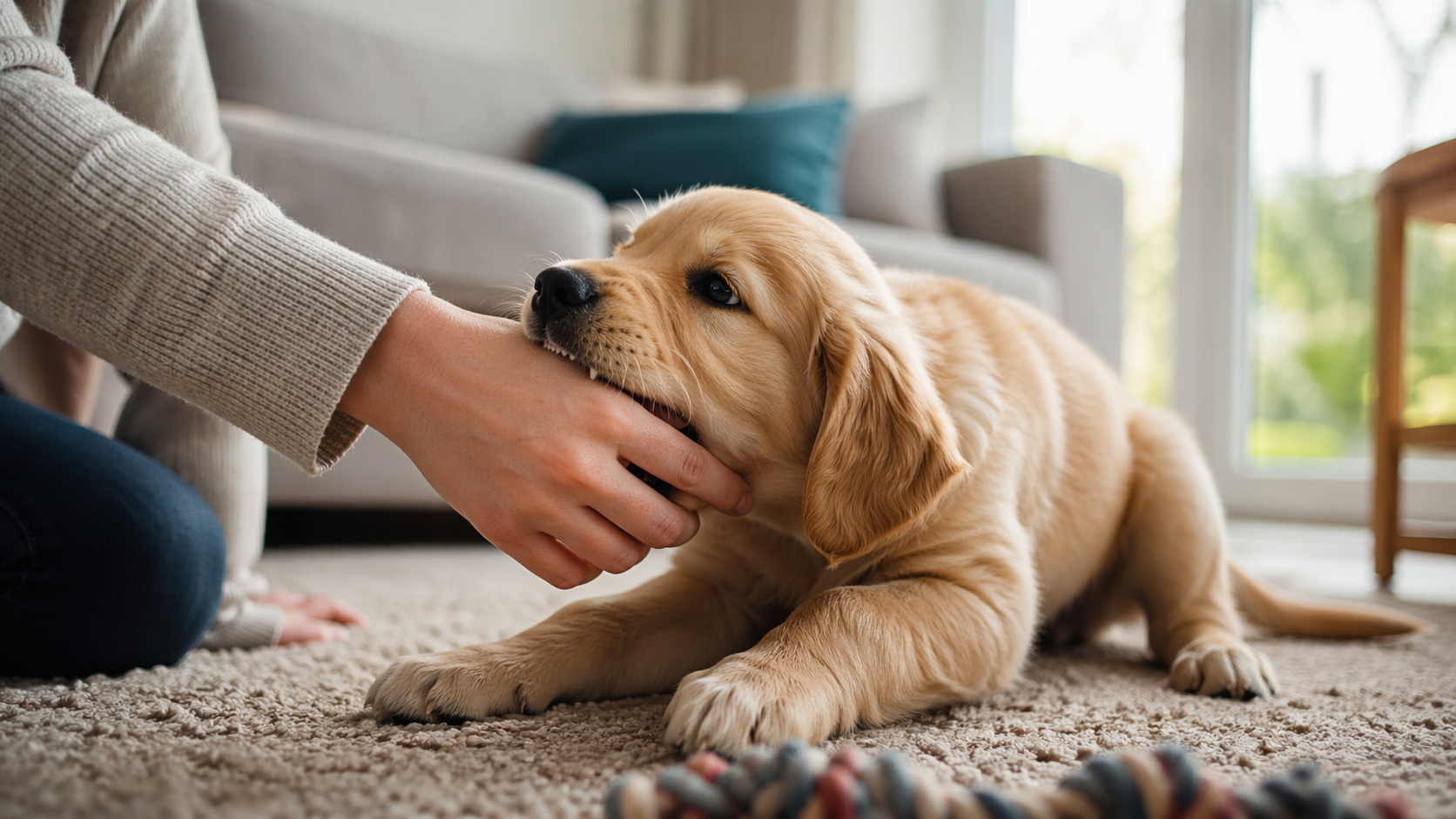
You’re feeling it right now — those sharp little teeth clamping harder than expected. This isn’t playful nibbling anymore. This is puppy biting hands aggressively, and it feels personal.
But stand still for a second. Watch closely.
Your puppy isn’t attacking you. They’re escalating a game you accidentally taught them how to win.
Right now, I’m going to walk you through exactly what’s happening — and more importantly — where you’re losing control.
What You’re Doing That’s Making It Worse (And Why It Escalates Fast)
You’re moving your hands.
That’s the mistake.
Not a big one — but it’s everything.
When your puppy bites and you pull your hand away quickly, you trigger chase instinct. When you wiggle your fingers, you simulate prey. When you say “no” while still engaging, you keep the game alive.
To your puppy, this is not correction.
This is level two of the same game.
Aha Insight: The bite doesn’t start the game — your movement does.
What’s Actually Happening (Frame-by-Frame Breakdown)
Let’s slow this down like we’re watching it in real time.
2:14 PM — Living room floor
Your puppy walks toward you. Loose body. Curious eyes.
Stimulus begins: your hand moves slightly — maybe adjusting position, maybe reaching.
→ Ears tilt forward
→ Eyes lock onto fingers
→ Micro-freeze (less than half a second)
→ Mouth opens slightly
You don’t notice this moment.
Then:
→ Puppy lunges forward
→ Teeth make contact
→ You react instantly — hand pulls back fast
Now the reinforcement kicks in.
→ Puppy chases your retreating hand
→ Grip tightens
→ You shake your hand or say “ouch” loudly
To the puppy:
This is now a moving target that reacts.
Game confirmed.
6:42 PM — Same day
The sequence repeats, but faster.
No hesitation this time:
→ Eye lock
→ Immediate lunge
→ Stronger bite pressure
Why?
Because the puppy learned:
Hands that move are worth grabbing.
And here’s the critical part:
The first signal — the eye lock and micro-freeze — is where you still have control.
After the bite starts?
You’re already late.
Why This Is NOT Teething or “Normal Puppy Play”
Yes, puppies bite. Yes, teething exists.
But this is different.
Teething biting:
→ Random chewing
→ Targets objects more than hands
→ Pressure fluctuates but not targeted
Play nibbling:
→ Soft mouth
→ Stops quickly when disengaged
→ No fixation on hands specifically
This behavior (aggressive hand biting):
→ Direct targeting of hands
→ Escalation when hands move
→ Re-engagement immediately after release
→ Eyes locked before action
This is not about teeth.
This is about pattern learning.
Your puppy has identified your hands as interactive prey that never truly “ends.”
Strong contrast:
A teething puppy chews because it needs relief.
This puppy bites because it expects a reaction.
That difference is everything.
How to Stop This BEFORE It Starts
This is your control point.
If you miss it, you’re reacting — not training.
Watch for this exact sequence:
→ Your hand shifts slightly
→ Puppy’s eyes lock onto it
→ Ears tilt forward
→ Body goes still for 1 second
This is your window.
1–2 seconds. No more.
If you act here, the bite never happens.
If you miss it:
→ Bite starts
→ Movement triggers chase
→ Reinforcement loop begins
If you miss this moment, stopping the behavior becomes significantly harder.
What you do in that window:
→ Freeze your hand completely
→ Do NOT pull away
→ Shift your gaze slightly away (not direct eye contact)
→ Use your other hand to calmly introduce a toy from the side (not front)
Direction matters:
Bring the toy in from 30–50 cm to the side, not toward the puppy’s face.
Why?
You’re redirecting attention — not competing with your own hand.
11:03 AM — Kitchen floor
Puppy locks eyes on your fingers.
You freeze.
Toy appears from the right side.
→ Eye shifts
→ Body turns
→ Bite redirected
No bite on skin.
That’s control.
Real-Time Action Script (Follow This Exactly)
When your puppy focuses on your hand:
1. WHEN: The moment you see eye lock (before movement)
→ DO: Freeze your hand completely
→ WHERE: Keep it exactly where it is
→ HOW FAR: Zero movement
→ WHY: Movement triggers chase instinct
2. WHEN: Within 1 second of freezing
→ DO: Turn your head slightly 20–30 degrees away
→ WHERE: Not full body, just head
→ HOW FAR: Small shift only
→ WHY: Removes social engagement signal
3. WHEN: Immediately after head turn
→ DO: Bring a toy into view from the side
→ WHERE: From 30–50 cm beside puppy’s head
→ HOW FAR: Keep it low and lateral
→ WHY: Redirects focus without triggering competition
4. WHEN: Puppy turns toward toy
→ DO: Slowly move your original hand backward
→ WHERE: Behind your body or thigh
→ HOW FAR: 20–40 cm
→ WHY: Removes target completely
5. WHEN: Puppy grabs toy
→ DO: Stay still for 2–3 seconds
→ WHERE: Maintain neutral posture
→ WHY: Prevents re-triggering
Precision Training Steps (Do Not Skip Details)
Step 1 — Remove Hand Movement Habit
At 4:22 PM on the couch, your puppy approaches your hand.
→ Keep your hand resting on your leg
→ Do NOT wiggle fingers
→ Do NOT pull away even slightly
→ Distance: maintain contact position
What NOT to do:
→ No tapping, no teasing movements
Why:
Still hands are boring. Moving hands are prey.
Step 2 — Interrupt Eye Lock Early
8:10 AM — bedroom floor
Puppy stares at your hand.
→ Within 1 second, look slightly away
→ Keep shoulders relaxed
→ Do not lean forward
Distance: head turns only, no body shift
Why:
Eye contact sustains engagement. Breaking it weakens intent.
Step 3 — Controlled Toy Entry
1:37 PM — hallway
→ Introduce toy from side angle (never front)
→ Distance: 40 cm from puppy’s mouth
→ Move slowly, not jerky
What NOT to do:
→ Don’t shove toy into mouth
Why:
You’re offering an alternative, not forcing a switch.
Step 4 — Remove the Target Cleanly
6:05 PM — near doorway
→ Once puppy engages toy, move your hand behind your thigh
→ Distance: 30 cm backward
→ Keep motion slow
What NOT to do:
→ No sudden withdrawal
Why:
Sudden movement reignites chase.
Step 5 — End the Interaction Properly
9:18 PM — living room
→ After 3 seconds of toy engagement, stand up slowly
→ Turn your body away 45 degrees
→ Take 2 steps back
What NOT to do:
→ Don’t re-engage immediately
Why:
You’re teaching: interaction has an off-switch.
Real Case Scenario
7-month-old Labrador, high energy.
Owner complained of “random aggressive biting.”
Reality:
Every time the puppy approached, the owner wiggled fingers and laughed.
Puppy learned:
Hands = game starter.
Correction:
We removed ALL hand movement for 3 days.
Introduced side-toy redirection exactly as described.
Result:
Day 2 — reduced lunging
Day 4 — no hand targeting
Day 7 — full disengagement from hands
Common Mistakes That Keep This Going
1. Pulling your hand away fast
Why it fails: triggers chase
What puppy learns: “grab it before it escapes”
2. Saying “no” while still moving
Why it fails: mixed signals
What puppy learns: “noise = game continues”
3. Using toys too late
Why it fails: bite already reinforced
What puppy learns: biting leads to toy reward
4. Letting puppy re-engage immediately
Why it fails: no clear stop point
What puppy learns: game never ends
If your puppy is showing multiple challenging behaviors at once, it’s important to see how they connect. You can find more step-by-step guidance in our dog behavior guides.
Final Reality Check
This problem feels like aggression.
It’s not.
It’s a pattern you can break fast — if you control the first second.
Fix the moment before the bite, and puppy biting hands aggressively disappears without a fight.