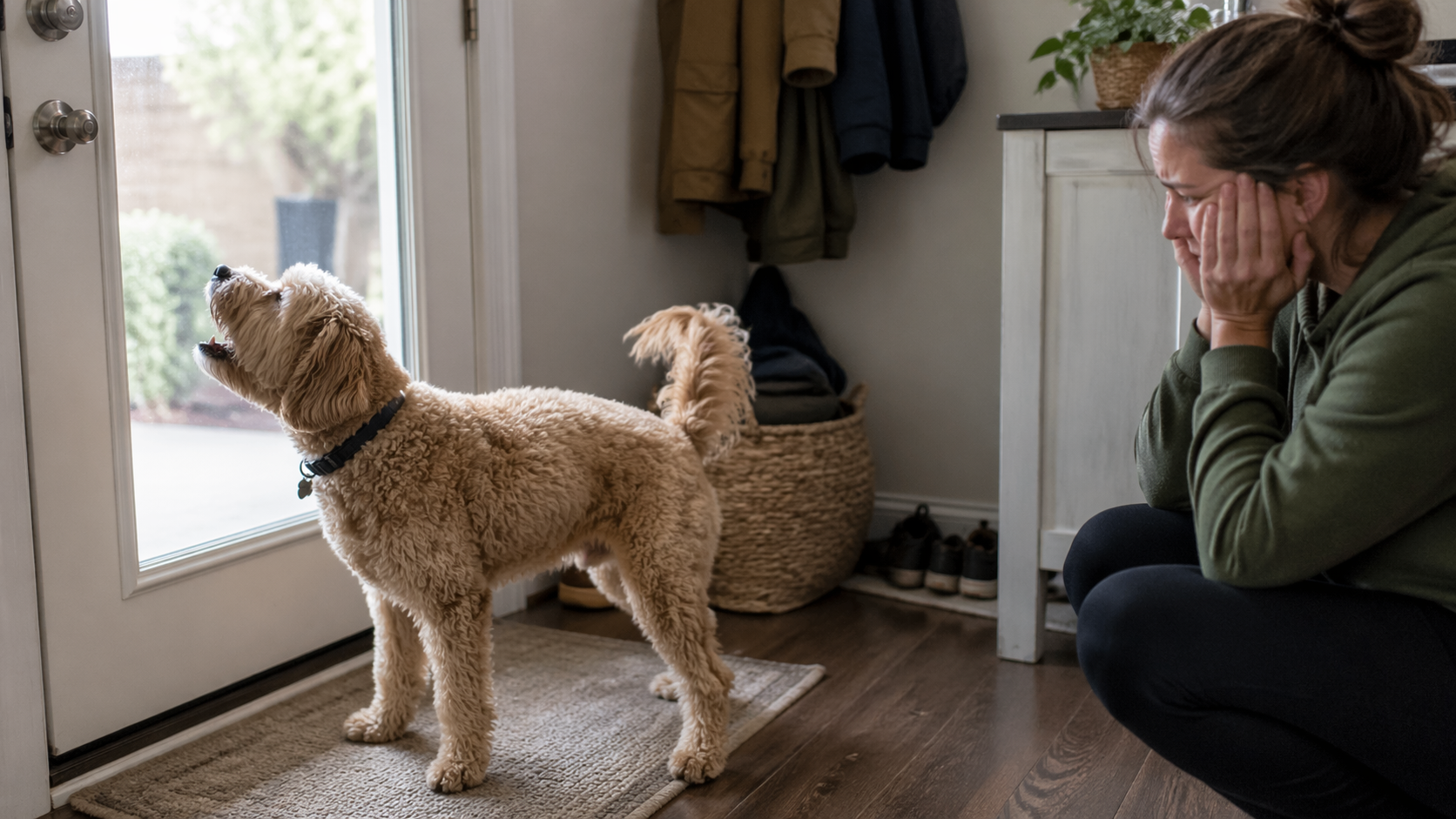
You’re not dealing with “random noise.” When you hear dog barking when left alone, what you’re actually hearing is a panic loop that started before you even touched the door. Right now, stand still and think about the last time you left. Keys picked up. Shoes on. Your dog’s head lifted. That was the start—not the bark.
What you think: “My dog barks because I’m gone.”
What’s actually happening: “Your dog panics the moment it predicts you’re about to leave.”
That prediction window is where we fix this. Not the barking.
What Actually Happens During Dog Barking When Left Alone
Watch this like slow motion.
You reach for your keys.
→ Your dog’s ears flick backward, not forward.
→ Eyes lock onto your hands, not your face.
→ A micro-freeze: 0.5–1 second.
→ Chest tightens, breathing shifts shallow.
→ Weight shifts slightly forward onto front paws.
→ Tail stiffens—not wagging, just held.
→ You move toward the door.
→ Dog follows, one step behind your left leg.
→ You touch the handle.
→ That’s the trigger spike.
Now the behavior chain completes:
Door opens
→ Dog’s body surges forward
→ First vocalization is NOT barking—it’s a sharp exhale
→ Then barking begins within 1–2 seconds
→ You leave
→ Barking escalates because there is no resolution
Reinforcement happens here:
The dog learns: “My anxiety peaks → owner disappears → barking releases pressure.”
Not because barking works—but because nothing interrupts it.
That’s why it repeats.
The confusion exists because you only hear the barking, but the behavior started 10–20 seconds earlier.
First visible signal: ears pulling slightly back when you pick up departure cues.
Control moment: that 1–5 second freeze before your dog follows you.
Miss that—and you’re chasing noise instead of controlling the trigger.
Why This Is NOT Attention Barking
This is where most owners go wrong.
Attention barking:
- Happens when you are present
- Dog looks at your face repeatedly
- Body is loose, tail often wagging
- Stops quickly when ignored or redirected
Separation-triggered barking:
- Begins before you leave
- Dog tracks your movement, not your face
- Body is tense, forward-leaning
- Does NOT stop—it escalates
At 7:42 AM, you grab your bag. Your dog doesn’t bark yet—but it shadows you, silent, glued to your leg. That’s not attention seeking. That’s surveillance behavior driven by anxiety.
Strong contrast:
Attention barking says: “Look at me.”
Separation barking says: “Don’t leave me.”
If you treat them the same, you make this worse.
You ignore attention barking.
You intercept separation anxiety before it spikes.
That difference is everything.
If your dog starts reacting before you even leave, you’re not dealing with simple barking behavior. That pattern is more closely linked to dogs that cry when left alone, where the response begins the moment your dog senses you’re about to go.
How to Stop This BEFORE It Starts
This is your control zone.
You are not fixing barking. You are stopping prediction.
Watch closely:
At 6:58 AM, you reach for your keys.
→ Your dog’s ears shift backward
→ Eyes lock onto your hand
→ Body pauses for a fraction of a second
That pause is your window.
You have 1–5 seconds here.
If you act inside that window, the chain breaks.
If you wait until the dog follows you, you’re already late.
Here’s the rule:
If you miss this moment, stopping the behavior becomes significantly harder.
Because once movement starts (dog following you), the brain has committed to the anxiety loop.
Your job is to interrupt BEFORE movement.
Not after the bark.
Not at the door.
Not when you’re halfway out.
Right there—at the freeze.
At 9:15 PM, you stand up casually. Your dog lifts its head but stays relaxed.
That’s neutral.
But when you pick up keys and see that tension spike? That’s your moment.
You’re not calming the dog.
You’re preventing escalation.
This is where real change happens.
Real-Time Action Script (Do This Exactly)
Follow this with precision. Timing matters more than intensity.
Step 1 — Intercept the Freeze
WHEN: The instant your dog’s ears shift back (within 1 second)
DO: Say “Hey” in a soft, neutral tone (not high-pitched)
WHERE: Face slightly away from your dog (about 30° angle)
HOW FAR: Stay exactly where you are—do NOT step forward
WHY: This interrupts fixation without adding pressure
Step 2 — Redirect Movement
WHEN: Immediately after saying “Hey” (no pause)
DO: Toss a treat 50–70 cm BEHIND your dog, slightly to its right side
WHERE: Aim so the dog must turn its head and body away from you
HOW FAR: The treat must land behind the shoulder line
WHY: This breaks forward tracking and resets body orientation
Step 3 — Freeze Your Body
WHEN: As soon as the treat leaves your hand
DO: Stop moving completely—no steps, no reaching
WHERE: Stay at least 1 meter away from the door
HOW FAR: Maintain that distance consistently
WHY: Movement toward the door re-triggers the chain
Step 4 — Reset the Context
WHEN: When your dog finishes the treat and looks around (not at you)
DO: Turn your back slightly and walk 2–3 slow steps away from the door
WHERE: Move toward the center of the room
HOW FAR: Each step about 30 cm
WHY: You dissolve the “departure pattern”
Step 5 — Repeat the Cue Without Leaving
WHEN: After 10–15 seconds of calm
DO: Pick up your keys again deliberately
WHERE: Same position as before
HOW FAR: No stepping toward the door yet
WHY: You teach that the cue no longer predicts departure
If your dog stays relaxed—you win that repetition.
If tension returns—you repeat the interrupt.
Precision Training Steps (Full Control System)
We’re going to install a new pattern. Stay precise.
Step 1 — Neutralizing the Trigger Object
At 8:05 AM, stand near your table. Pick up your keys slowly.
The moment your dog’s ears shift back:
→ Within 1 second, drop the keys back down gently
→ Turn your body 45° away from the dog
→ Take one step (30–40 cm) backward
→ Do NOT look at your dog
What NOT to do: Don’t speak, don’t pet, don’t reassure.
Why: You’re teaching that the trigger does not escalate.
Micro scenario: Your dog starts to follow—but pauses because you disengaged first.
Step 2 — Controlled Redirection
At 12:20 PM, repeat the key pickup.
When tension appears:
→ Within 1 second, toss a treat 60 cm behind the dog’s left side
→ Keep your shoulders facing away from the door
→ Do NOT step toward the dog
What NOT to do: Don’t throw the treat toward the door.
Why: Forward motion feeds anxiety tracking.
Micro scenario: Dog turns away fully, breaking eye lock.
Step 3 — Door Desensitization Without Exit
At 3:40 PM, walk toward the door slowly.
Stop 1 meter before reaching it.
If your dog stiffens:
→ Immediately step backward 2 steps (60–80 cm total)
→ Turn your back slightly
→ Wait 5 seconds
What NOT to do: Don’t touch the handle yet.
Why: You’re preventing threshold crossing.
Micro scenario: Dog hesitates instead of following fully.
Step 4 — Handle Contact Reset
At 6:10 PM, repeat approach.
This time, touch the handle lightly.
The moment your dog shifts weight forward:
→ Release the handle instantly
→ Toss a treat 50 cm behind the dog
→ Step sideways 1 step (30 cm), not backward
What NOT to do: Don’t open the door.
Why: You’re isolating the trigger without completing the sequence.
Micro scenario: Dog stops associating handle with immediate departure.
Step 5 — Micro-Exits
At 9:00 PM, open the door 5–10 cm.
Wait 2 seconds.
Close it again.
If your dog stays calm:
→ Toss treat behind
→ Walk away from door
If tension spikes:
→ Close door immediately
→ Step back 2 steps (60 cm)
What NOT to do: Don’t step outside yet.
Why: You’re building tolerance gradually.
Micro scenario: Dog watches but does not surge forward.
Step 6 — Real Exit With Control
After multiple calm repetitions:
At 7:30 AM next day:
→ Open door fully
→ Step out ONE step (30–40 cm)
→ Pause 2 seconds
→ Step back inside
If calm persists, extend duration slowly.
This is how you break the chain safely.
Real Case Scenario
A 2-year-old Border Collie, Milo.
Owner mistake: grabbing keys and leaving quickly to “avoid drama.”
Result: barking escalated daily.
Correction:
- Intercepted ear movement during key pickup
- Removed full exits for 3 days
- Rebuilt departure in micro-steps
Timeline:
- Day 2: barking reduced by 40%
- Day 5: no barking during short exits
- Day 10: calm departures up to 15 minutes
The fix wasn’t calming Milo.
It was removing prediction.
Common Mistakes That Make It Worse
1. Talking to the dog before leaving
Why it fails: adds emotional intensity
Dog learns: “This moment is important → panic”
2. Sneaking out
Why it fails: removes learning opportunity
Dog learns: “Owner disappears unpredictably”
3. Correcting barking after leaving
Why it fails: too late in the chain
Dog learns nothing about the trigger
4. Using punishment collars
Why it fails: adds fear to anxiety
Dog learns: “Leaving = pain + panic”
If your dog also struggles with nighttime crate noise, it can be related to a similar anxiety loop—see puppy barking in crate at night for comparison.
Separation-related barking is often part of a larger pattern. For a broader breakdown of similar behaviors and how to fix them, check our dog behavior guides.
Final Insight
The barking isn’t the problem—the prediction is.
Fix that, and the noise disappears.
When you control the first 3 seconds, you control the entire outcome of dog barking when left alone.