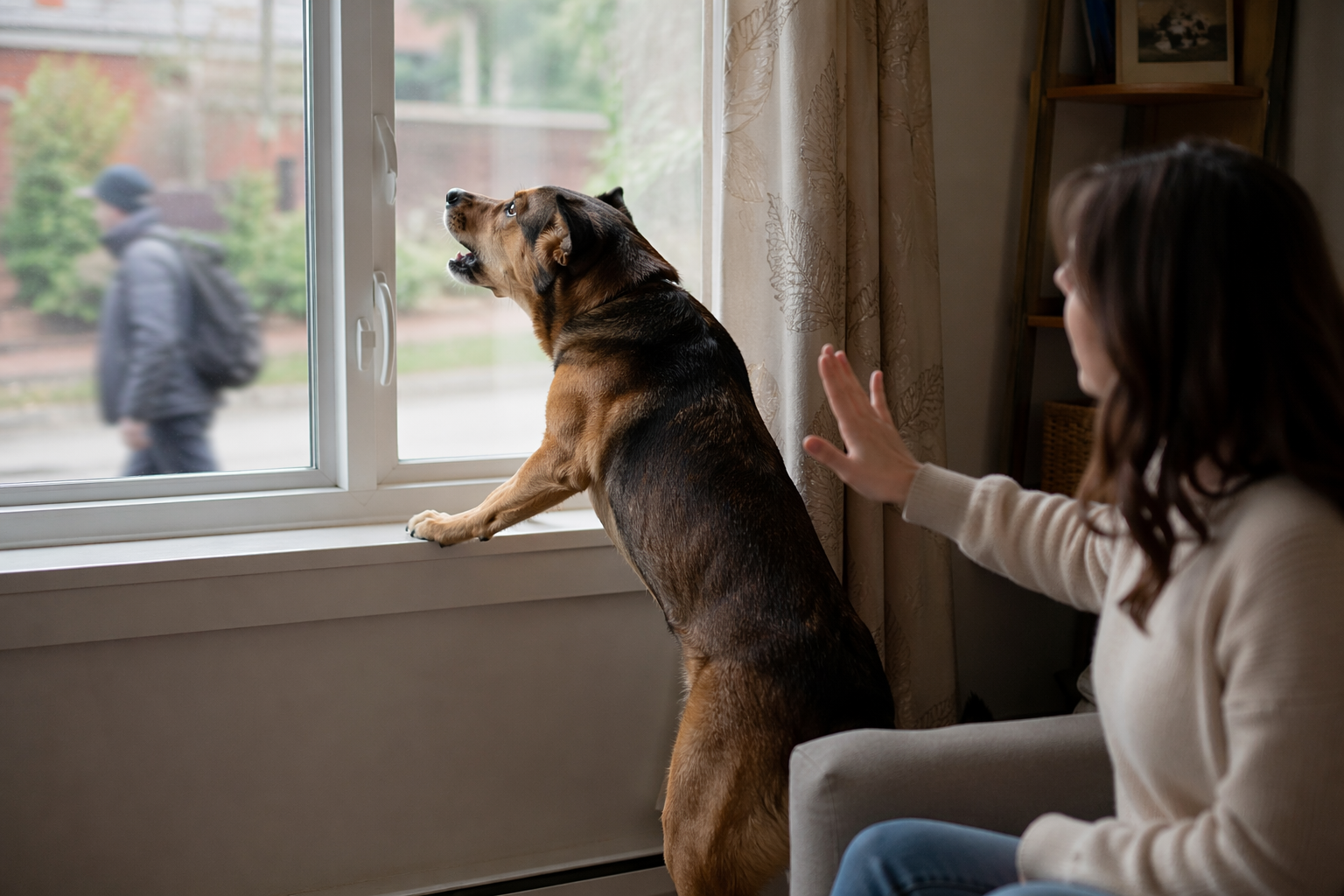
You’re standing in your living room. The door clicks. Your dog stiffens—then explodes into barking at the stranger outside. But ten minutes later? That same dog is calmly lying beside a guest you invited in.
This is the exact pattern behind dog barking at strangers but not guests. And right now, you’re not dealing with “random barking.” You’re watching a territorial detection system turning on and off based on familiarity.
I’m going to walk you through this as if I’m right next to you. Because the fix doesn’t happen after the barking—it happens seconds before it starts.
What You Think vs What’s Actually Happening
You think: “My dog is aggressive or unpredictable.”
What’s actually happening: Your dog is making a fast decision: “Unknown = potential threat. Known = safe.”
Why confusion exists: Because once a guest is accepted, your dog flips instantly—making it feel inconsistent.
First visible signal: Head lift + ear angle change toward the door or window.
Control moment: The instant your dog locks onto the stimulus—but before sound comes out.
AHA INSIGHT: Your dog isn’t reacting to people—it’s reacting to uncertainty.
Behavior Chain (Watch This in Slow Motion)
Let’s slow this down like we’re replaying it frame by frame.
Stimulus: Footsteps outside. A shadow passes the gate. A knock. Even subtle sounds like keys.
Ear/Eye Movement: Within 0.5 seconds, your dog’s ears rotate forward. Eyes narrow slightly. The head lifts—not fully, just enough to scan.
Micro Freeze: This is tiny. Less than 1 second. The body pauses mid-breath. Tail stops moving if it was wagging.
Tension Shift: Weight moves forward onto front paws. Chest expands. Mouth closes. You’ll see a slight tightening around the lips.
Decision Point: Brain asks: “Do I know this?” If no immediate recognition → escalation.
Action: Bark. Not random—sharp, directional, aimed at the stimulus.
Reinforcement:
- Stranger moves away → dog thinks barking worked
- You react emotionally → adds intensity
- No interruption → pattern locks in
Now compare that to guests:
The same initial detection happens—but once scent, voice, and your relaxed behavior confirm safety, the chain stops before barking escalates.
So your dog isn’t inconsistent. It’s completing two different chains based on recognition speed.
Why This Is NOT General Barking or Aggression
This is not the same as random barking or uncontrolled reactivity.
Territorial Stranger Barking:
- Triggered by boundary (door, gate, window)
- Stops once person is “approved”
- Focused, directional barking
General Barking Problems:
- Triggered by boredom, noise, or excitement
- Not tied to unfamiliar humans
- Often repetitive and unfocused
Aggression toward visitors:
- Continues even after entry
- Includes lunging, snapping, or avoidance
- Does NOT settle with familiarity
Sharp contrast: Your dog stops once the person becomes “known.” That’s not aggression—that’s controlled territorial filtering.
However, if your dog reacts more intensely when someone actually enters your home, this may go beyond simple alert barking. In that case, you’re likely dealing with visitor-triggered aggression inside the home, where the dog feels responsible for controlling the space.
How to Stop This BEFORE It Starts
This is your most important section. Miss this, and everything becomes harder.
Exact first signal:
- Head lifts 2–5 cm
- Ears angle forward
- Eyes lock toward door/window
You have 1–5 seconds here.
This is where you interrupt the decision—not the barking.
If you miss this moment, stopping the behavior becomes significantly harder.
Once barking starts:
- Adrenaline is already released
- Your dog is committed to the “threat response”
- You are now fighting momentum, not guiding behavior
So your job is not to “stop barking.”
Your job is to break the chain before it forms.
What you do in this window:
- Interrupt focus
- Redirect movement
- Change emotional state
We’re going to make the dog disengage BEFORE it decides to bark.
Real-Time Action Script (Do This Exactly)
We’re standing together. Someone is approaching outside.
Moment 1 – Detection (0 seconds)
WHEN your dog’s head lifts slightly:
→ within 1 second, say “yes” softly (not loud, not sharp)
→ DO NOT move toward the door
→ keep your shoulders relaxed and angled slightly away from the trigger
→ WHY: you mark awareness without confirming threat
Moment 2 – Interrupt Focus (1–2 seconds)
→ immediately toss a treat 50–70 cm BEHIND your dog, slightly to the side (not straight back)
→ keep your arm low and smooth
→ WHY: forces full head and body disengagement from stimulus
Moment 3 – Reposition (2–4 seconds)
→ as your dog turns, take ONE step diagonally backward (about 40 cm)
→ do NOT step toward the door
→ WHY: you pull the dog out of the “front-line” position
Moment 4 – Reset (4–6 seconds)
→ as your dog finishes the treat, quietly say “good”
→ avoid eye contact with the door
→ WHY: reinforces calm disengagement, not alertness
Repeat if needed BEFORE barking starts.
Precision Training Steps (Locked System)
Step 1 – Control the First Look
Scenario (7:12 PM): Someone walks past your gate.
WHEN your dog’s ears flick forward:
→ within 1 second, softly say “yes”
→ toss treat 60 cm behind rear left paw
→ keep your feet planted
→ DO NOT call the dog toward you
→ WHY: calling forward increases forward drive; we want backward disengagement
Step 2 – Break the Forward Lean
Scenario (2:18 PM): Delivery person pauses outside.
WHEN weight shifts onto front paws:
→ step diagonally back 30–50 cm
→ angle your torso 45° away from door
→ toss treat slightly behind and outward (not straight back)
→ DO NOT block your dog physically
→ WHY: physical blocking increases tension; movement invites release
Step 3 – Prevent Sound Release
Scenario (8:03 AM): Knock on door.
WHEN mouth closes tightly (pre-bark):
→ immediately drop treat between dog’s front paws (not thrown)
→ keep your hand low, 10–15 cm from floor
→ DO NOT speak loudly
→ WHY: interrupts breath pattern required for barking
Step 4 – Create a New Pattern
Scenario (5:47 PM): Neighbor walks by daily.
WHEN your dog notices but hasn’t barked:
→ toss treat 40 cm behind consistently every time
→ stand still, avoid staring at trigger
→ DO NOT skip repetitions
→ WHY: builds automatic “see stranger → turn away” loop
Step 5 – Owner Body Awareness
Scenario (9:10 PM): Night movement outside.
WHEN you hear something first:
→ do NOT tense or rush forward
→ shift your weight back slightly (heels grounded)
→ keep arms loose at sides
→ WHY: your tension confirms threat faster than the stimulus itself
Real Case Scenario
Border Collie, 3 years old.
Problem: Explosive barking at anyone passing the gate, calm with guests after 2 minutes.
Mistake: Owner waited until barking started, then yelled or called the dog.
Correction: We trained interrupting at ear movement + treat toss behind.
Timeline:
- Day 1–3: barking reduced but still triggered occasionally
- Day 7: dog consistently disengaging before bark
- Day 14: dog automatically turning away when seeing strangers
No punishment. Just timing.
Common Mistakes
1. Waiting for barking
Why it fails: you’re too late
Dog learns: barking is part of the process
2. Calling the dog toward you
Why it fails: increases forward engagement first
Dog learns: approach + bark sequence
3. Stepping toward the door
Why it fails: confirms threat presence
Dog learns: escalate with owner
4. Saying “no” loudly
Why it fails: adds energy, not clarity
Dog learns: excitement = bark more
If your dog reacts differently in other situations, it helps to see how these behaviors connect. You can find more real-world fixes inside our dog behavior guides.
Final Coaching Note
The solution to dog barking at strangers but not guests is not control after the fact—it’s interception before commitment.
Watch the ears. Watch the head. Act within seconds.
And remember:
You are not stopping barking—you are preventing the decision to bark.
If nighttime triggers are making this worse, you’ll want to look at dog barking at night for no reason as it often overlaps with low-visibility detection behavior.