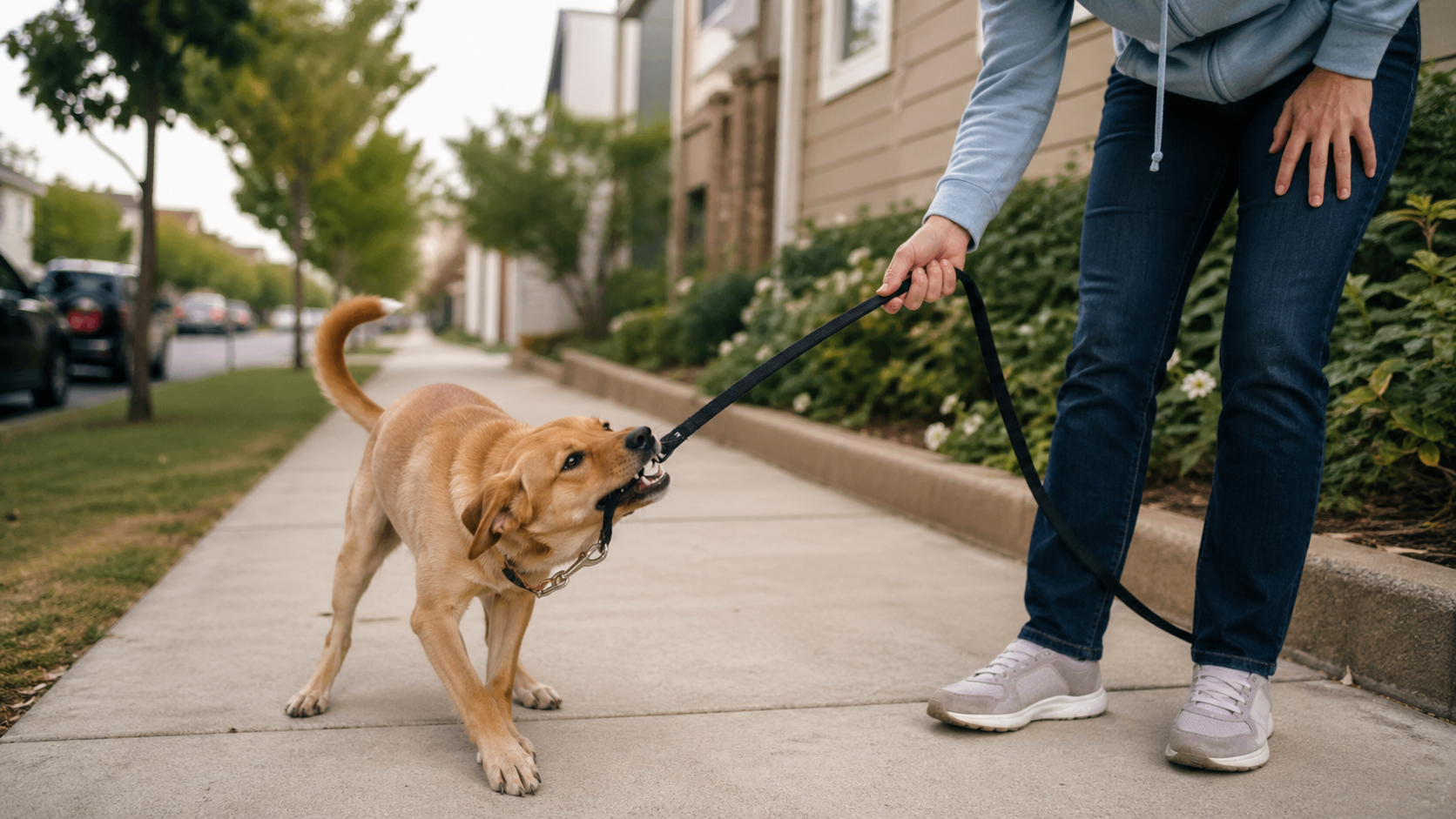
You’re mid-walk, leash in hand, and suddenly your dog spins, grabs the leash, and starts biting it like it’s a tug toy.
It feels random. Maybe even aggressive.
It’s not.
This specific pattern—dog biting leash during walks—is almost always frustration overflowing through the closest available object: the leash.
And here’s the part most people miss:
The biting isn’t the behavior—it’s the release of pressure that built seconds before.
So before we fix anything, I want you to slow this down.
Picture the exact moment it starts. Because that’s where we take control—not during the bite, but just before it.
Trigger Breakdown: Exactly When Dog Biting Leash During Walks Starts
This is a trigger-first behavior. It follows a repeatable pattern every time.
If you watch closely, the sequence looks like this:
Stimulus → Forward movement is blocked (you stop, turn, or shorten leash)
Eyes → Quick glance back at you, then forward again
Ears → Slight flick backward
Micro-freeze → Half-second hesitation in stride
Tension → Leash tightens, chest leans forward
Action → Head drops, mouth grabs leash
Escalation → Tugging, shaking, jumping upward
Reinforcement → Movement resumes OR you react
This entire chain happens in about 2–4 seconds.
And this is the key shift:
The bite is not the start. It’s the outlet.
Your dog is building pressure before that moment.
AHA Insight: The leash isn’t the problem—the blocked movement is.
Micro-scenario — 5:42 PM, sidewalk corner:
You stop to check your phone.
Your dog takes two steps forward, hits leash tension.
Head turns back.
Ears flick.
Tiny pause.
Then—snap—grabs the leash.
You think: “Why is my dog attacking the leash?”
But from the dog’s perspective:
“Why did movement stop?”
Why This Is NOT Aggression or Play
This is where mislabeling creates bigger problems.
Most owners assume:
- “My dog is being aggressive”
- “My dog is trying to play”
Neither is correct.
Leash Frustration (THIS behavior):
- Triggered when movement is blocked
- Body leans forward—not loose
- Eyes flick between path and handler
- Builds tension before action
- Stops when movement resumes
Play Behavior:
- Loose, bouncy movement
- Play bow before engagement
- No tension buildup
- Initiated voluntarily
Aggression:
- Directed at a person or animal—not an object
- Hard stare, sustained tension
- Independent of leash pressure
Clear distinction:
This behavior only exists because the leash is blocking something your dog wants.
That’s why it often appears alongside reactivity on walks or pulling—not resource issues like food guarding.
Different trigger. Different solution.
How to Stop This BEFORE It Starts
This is the control point that changes everything.
You are not fixing the bite.
You are intercepting the moment before it forms.
First signal:
→ The head turn back toward you after leash tension appears
That’s your window.
You have 1–2 seconds.
If you miss this moment, stopping the behavior becomes significantly harder.
Because after that:
- Motor pattern activates
- Adrenaline spikes
- Now you’re in a physical struggle—not training
Micro-scenario — 7:10 AM:
You stop walking.
Leash tightens.
Dog glances back.
That glance is the entire opportunity.
Act there—and the behavior never escalates.
Real-Time Action Script (Do This Exactly)
This sequence replaces frustration with control.
Moment 1 — Leash tension appears
WHEN:
→ Dog reaches leash limit
DO:
→ Stop moving completely
WHY:
→ Removes forward pressure conflict
Moment 2 — Dog glances back
WHEN:
→ Within 1 second of tension
DO:
→ Say “Yes” (soft marker)
→ Drop treat 30–50 cm behind your dog
WHY:
→ Forces disengagement from forward drive
Moment 3 — Dog turns back
DO:
→ Take 1–2 diagonal steps backward
WHY:
→ Breaks forward pressure loop
Moment 4 — Dog reorients
DO:
→ Resume walking
WHY:
→ Movement becomes the reward
Precision Training Steps (Build Control Fast)
Step 1 — Controlled Stops
Stop every 10–15 steps during calm walks.
Goal: Dog learns stops are normal—not frustrating.
Step 2 — Reinforce Look-Back
Mark and reward the glance back immediately.
Goal: Automatic disengagement.
Step 3 — Movement Reset
Step backward as dog turns.
Goal: Break forward drive pattern.
Step 4 — Resume Walk
Continue walking only after calm reset.
Goal: Calm behavior = progress.
Step 5 — Interrupt Pre-Bite
If head drops toward leash → step back instantly.
Goal: Remove opportunity before contact.
Step 6 — Build Frustration Tolerance
Repeat in low-distraction areas first.
Goal: Gradual emotional control.
Common Mistakes That Make It Worse
Pulling the leash upward
Triggers tug reflex → becomes a game
Saying “No” too late
Behavior already completed → no learning
Letting it “burn out”
Reinforces habit → repetition builds pattern
Turning it into play
Confirms leash = toy under pressure
Real Case: 10-Month-Old Labrador
Issue: Leash biting whenever walk paused
Mistake:
Owner pulled leash + verbal corrections
Result:
Leash became interactive frustration outlet
Fix:
Look-back interrupt + backward reset
Timeline:
Day 2 → reduced intensity
Day 5 → no biting (low distraction)
Day 10 → replaced with automatic check-in
Conclusion: Control the Moment Before It Happens
Dog biting leash during walks isn’t about the leash.
It’s about frustration when movement is blocked.
You don’t fix it by reacting to the bite.
You fix it by owning the 1–2 second window before it starts.
Watch the head turn.
That’s your signal.
That’s your control point.
And once you control that moment, the biting disappears—because the pressure never builds.
If you want to understand how this connects to bigger behavior patterns, explore dog behavior guides.