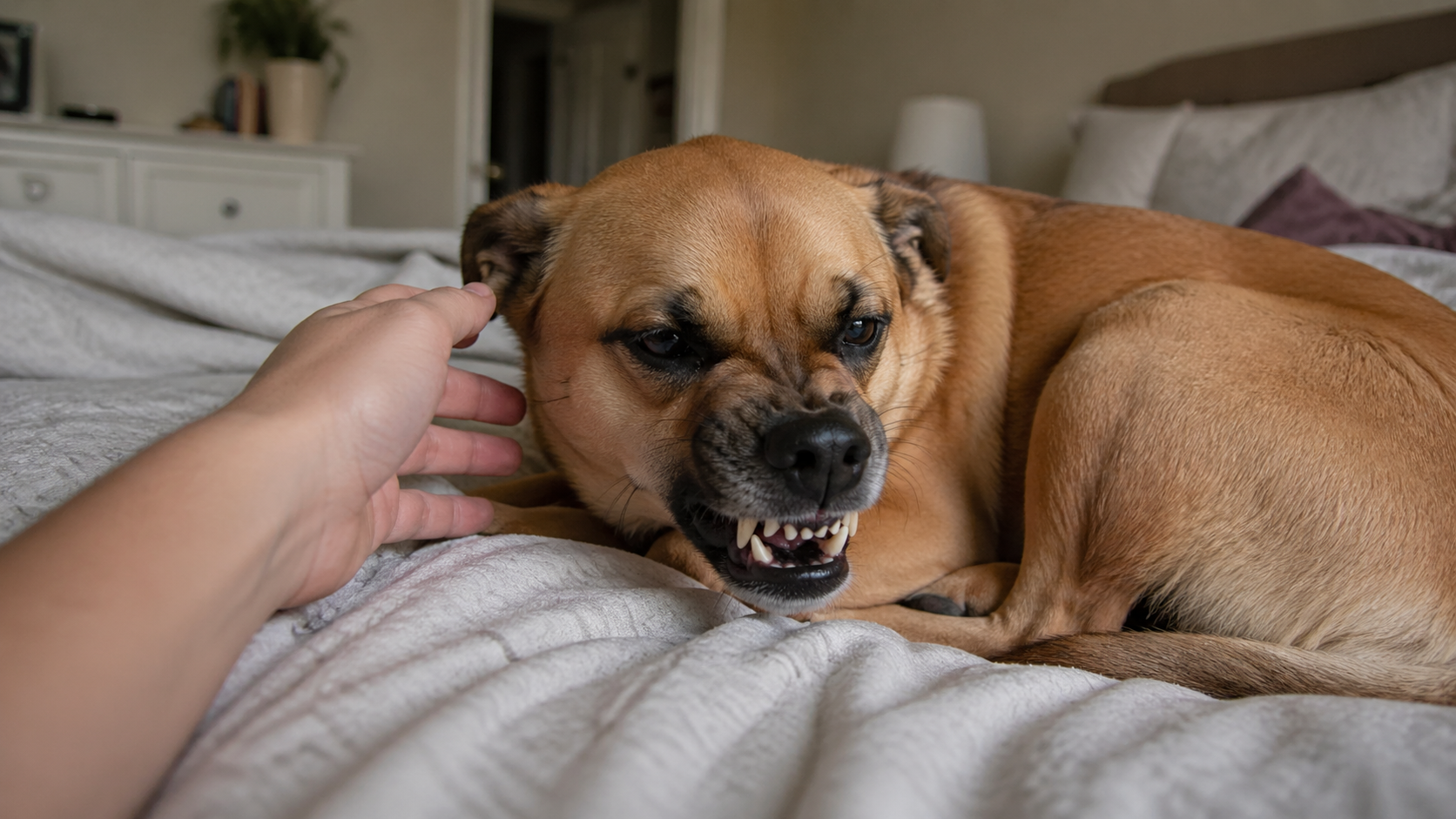
You reach down to pet your dog while they’re asleep… and suddenly—low growl, maybe even a snap.
You’re thinking: “That was aggressive. That’s not okay.”
I’m going to stop you right there.
In that moment, your dog isn’t fully awake—so the reaction isn’t a choice, it’s reflex.
This specific situation—dog growling when touched while sleeping—is not random aggression. It’s a reflex. A defensive startle response.
This is called a startle reflex response—not learned aggression.
Right now, I want you to picture the exact moment this happens. Because the fix isn’t about correcting the growl. It’s about controlling the 1–2 seconds before the dog fully wakes.
We’re going to break that down frame by frame so you can step in at the exact moment it matters. Situations like this are often misunderstood and grouped with behaviors such as dogs acting aggressive toward visitors, even though the trigger is completely different.
Trigger Moment — What Actually Happens When You Touch a Sleeping Dog
Let’s slow this down like we’re watching it in real time.
Stimulus:
Your hand enters the dog’s space while they’re asleep. No warning. No sound. Just sudden touch.
0.2 seconds:
The dog’s ears twitch. Eyes are still closed. Brain is not fully awake.
0.5 seconds:
Micro-freeze. Muscles tense instantly. This is not conscious thinking—it’s survival wiring.
0.8 seconds:
Eyes snap open. But here’s the key: the brain hasn’t identified you yet.
1.0 second:
Body shifts slightly backward or stiffens. Lips tighten.
1.2 seconds:
Low growl. Not “I want to hurt you.” It’s: “Something touched me and I don’t know what it is.”
1.5–2.0 seconds:
If pressure continues (you keep touching, leaning, or reaching): snap or air bite.
Then—2.5 seconds onward:
Recognition kicks in. The dog realizes it’s you.
And this is where owners get confused.
The dog looks “guilty” or relaxes. But the behavior already happened.
Why confusion exists:
You’re interacting with a half-asleep brain, not your fully conscious dog.
First visible signal:
That tiny ear flick or sudden stillness before the growl.
Control moment:
Before physical contact—or within the first 0.5 seconds of movement.
Aha insight:
Your dog isn’t reacting to you—it’s reacting before it knows it’s you.
Why This Is NOT Aggression Toward You
Let’s make this very clear so you don’t mislabel your dog.
This is not the same as a dog showing hostility toward its owner during waking hours.
Compare it directly:
Sleeping Touch Reaction:
• Happens only during sleep or deep rest
• Trigger = unexpected physical contact
• Ends quickly once the dog wakes fully
• No follow-up aggression
True Owner-Directed Aggression:
• Happens when dog is fully awake
• Trigger = resource guarding, fear, control conflict
• Sustained tension, stalking, or repeated warnings
• Escalates if challenged
In your case:
Environment = quiet, resting state
Trigger = sudden touch
Reaction = reflex defense
That’s a neurological startle response.
Not a relationship issue.
This is not behavior you train out—it’s a moment you manage.
This is why punishing the growl here is a mistake. You’d be punishing a reflex your dog can’t control.
If you treat it like disobedience, you’ll remove the warning and keep the reaction.
That’s how bites happen “without warning.”
Mislabeling this can lead owners down the wrong path, similar to what happens in cases like sudden aggression toward the owner, where the root cause is often misunderstood.
How to Stop This BEFORE It Starts
This is the most important part. Everything depends on what happens before contact.
You are not going to “fix” the growl after it starts. You prevent the startle entirely.
First signal to watch:
Stillness during sleep combined with deep breathing. This is when your dog is in a deeper sleep phase—highest risk for startle reaction.
How to recognize deep sleep:
• Slow, steady breathing
• Body fully relaxed (no twitching)
• Eyes fully closed (not fluttering)
• No ear movement when environment shifts
Your window:
1–5 seconds BEFORE touch.
What you must do:
Wake the brain before the body feels contact.
How:
• Soft voice cue (name or calm word)
• Light environmental noise (step, shift, small sound)
• Gentle air disturbance before touch (moving hand nearby, not contacting yet)
At 2:18 AM, your dog is curled tightly, breathing slow and deep.
You move your hand directly onto their side—this is where mistakes happen.
Instead:
At 2:18:02 AM, you softly say their name from 1–2 meters away.
At 2:18:04 AM, their ear flicks. Head slightly shifts.
Now the brain is waking.
At 2:18:06 AM, THEN you touch.
No growl. No tension.
If you miss this moment, stopping the behavior becomes significantly harder.
Because once the reflex is triggered, you’re dealing with instinct—not learning. This timing principle is also critical in other fast-escalation behaviors like snapping during feeding, where early interruption changes the outcome.
Real-Time Action Script (Exact Control Sequence)
We’re going to run this like a drill. Follow the sequence exactly.
Step 1 — Pre-Approach Positioning
WHEN: You decide to approach a sleeping dog
DO: Stop 1–1.5 meters away
WHERE: Stand slightly off to the side, not directly over the dog
HOW FAR: One full step outside their body reach
WHY: Direct overhead approach increases perceived threat during wake-up
Micro scenario: At 9:40 PM, your dog is on the couch. You pause beside the armrest—not leaning in.
Do NOT: reach immediately or hover over their face.
Step 2 — Controlled Wake Signal
WHEN: Before any physical movement toward the dog
DO: Say their name softly once
WHERE: Keep your head angled slightly away, not looming forward
HOW FAR: Voice delivered from current position (1–1.5 m)
WHY: This activates auditory processing before physical sensation
Micro scenario: At 6:12 AM, you quietly say “Buddy…”—not loud, not repeated.
Do NOT: clap, snap, or startle them awake.
Step 3 — Watch the Micro-Wake Response
WHEN: Within 1 second after the cue
DO: Look for ear flick, nose twitch, or slight head lift
WHERE: Stay still—do not move closer yet
HOW FAR: Maintain same distance
WHY: This tells you the brain is transitioning out of sleep
Micro scenario: At 6:12:02 AM, ear flick. That’s your green light forming.
Do NOT: assume they’re awake just because you spoke.
Step 4 — Gradual Entry Into Space
WHEN: After visible micro-wake signal
DO: Take one slow step closer
WHERE: Approach from side of shoulder—not head-on
HOW FAR: Close gap to about 50–70 cm
WHY: Side approach reduces perceived threat and allows visual recognition
Micro scenario: At 6:12:04 AM, you shift one step closer—slow, no sudden motion.
Do NOT: move fast or reach during the step.
Step 5 — Air Contact Before Physical Contact
WHEN: Now within arm’s reach
DO: Move your hand slowly into their space WITHOUT touching
WHERE: Hover 5–10 cm above shoulder area
HOW FAR: No contact yet
WHY: This gives the dog one last sensory cue before touch
Micro scenario: At 6:12:06 AM, your hand is hovering—dog’s eyes now open.
Do NOT: go straight to petting.
Step 6 — First Touch (Safe Zone)
WHEN: Eyes open or head lifts slightly
DO: Touch shoulder or side—not head or face
WHERE: Side of body, mid-rib area
HOW FAR: Light contact only, no pressure
WHY: This area is least threatening during wake transitions
Micro scenario: At 6:12:08 AM, you make contact—dog remains relaxed.
Do NOT: touch paws, face, or neck first.
Real Case Scenario (What This Looks Like in Practice)
Client case:
3-year-old mixed breed, medium size.
Issue: Growling and snapping when owner touched him during sleep on the bed.
Mistake:
Owner would reach over from above and pet the dog’s head without waking him.
Result:
Immediate growl → one snap incident.
Correction:
We implemented the exact wake-sequence protocol.
Timeline:
Day 1–2: Dog still startled slightly but no growling
Day 3–5: Full wake before contact, no tension
Day 7+: Owner could wake dog calmly every time
No “training commands.” No punishment. Just controlling the trigger chain.
Common Mistakes That Make This Worse
1. Touching first, speaking after
Why it fails: Physical contact hits before recognition
What dog learns: “Touch = threat during sleep”
2. Punishing the growl
Why it fails: Suppresses warning, not reflex
What dog learns: Skip warning → go straight to snap
3. Waking too abruptly
Why it fails: Triggers same startle response via sound
What dog learns: Sudden wake = danger
4. Reaching for the head immediately
Why it fails: Face is high-sensitivity zone
What dog learns: Defensive reaction escalates faster
5. Leaning over the dog
Why it fails: Creates pressure and perceived threat
What dog learns: Defensive posture activates sooner
Conclusion — What This Really Means
Dog growling when touched while sleeping is not your dog turning aggressive.
It’s your timing colliding with their instinct.
Fix the timing, and the behavior disappears.
If you’re seeing other aggressive patterns outside of sleep, you’ll want to compare that with this breakdown, look at situations like visitor-triggered aggression, or explore broader patterns in behavior guides.
But in this situation?
You don’t correct the dog.
You control the wake-up.