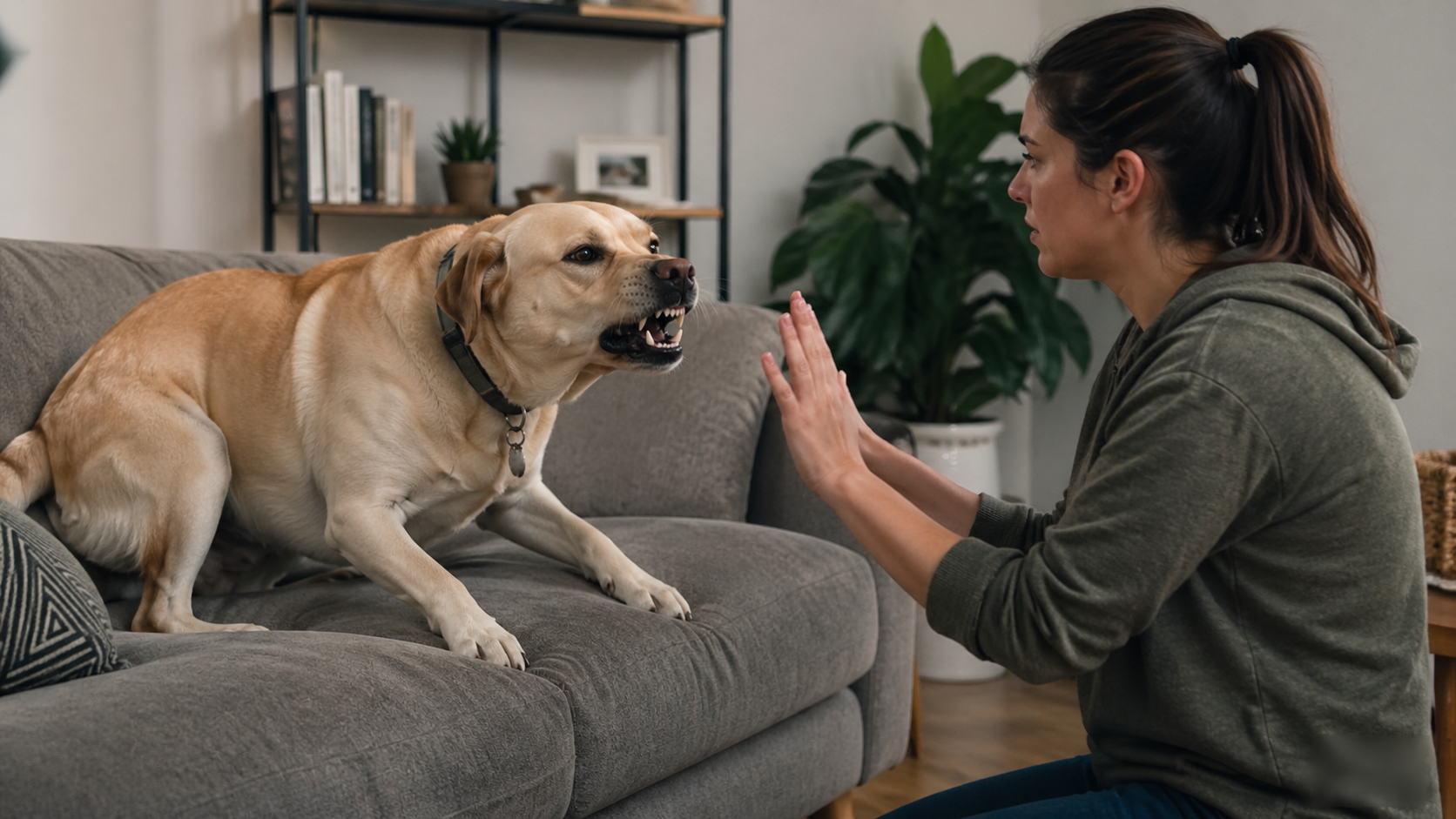
You’re telling me your dog is suddenly aggressive towards you. That word “suddenly” matters—but in almost every real case, the dog didn’t change overnight. You just didn’t see the earlier signals.
Right now, I want you to shift from thinking “my dog snapped” to “my dog escalated.” Because what feels sudden to you is usually a missed sequence of warnings.
We’re going to break this down like I’m standing next to you, watching your dog in real time. In some cases, owners confuse this pattern with behaviors like dogs reacting aggressively to visitors, even though the trigger and context are completely different.
If this behavior appears suddenly, rule out medical causes first. Pain or discomfort can completely change how a dog reacts to touch, movement, or interaction—even with its owner.
What Type of “Dog Suddenly Aggressive Towards Owner” Are You Actually Seeing?
I’m watching your dog, not your label.
Before you try to fix this, you need to understand what type of behavior you’re actually dealing with.
There are three common behavior types behind this situation:
- Handling aggression → triggered when you touch, move, or restrain
- Resource guarding → triggered near food, toys, space
- Pain or discomfort aggression → triggered by physical sensitivity
You think: “He turned on me.”
What’s actually happening: your dog is reacting to a specific trigger that now crosses his tolerance threshold.
The confusion exists because the trigger is subtle—or delayed.
Let me show you exactly what that looks like in slow motion.
Why This Is Not Random Aggression
It may feel sudden, but aggression is almost never random.
Dogs give subtle signals before reacting—stiff posture, stillness, avoidance, or tension. These signals are often missed until the reaction becomes obvious.
What looks like “out of nowhere” is usually a moment where the warning signs went unnoticed.
This is especially true in scenarios like being touched while sleeping, where the reaction feels instant but is actually a reflex-based sequence.
The Behavior Chain You’re Missing (Frame by Frame)
Let’s replay a real moment.
2:18 PM — Living room. You reach toward your dog on the couch.
Stimulus:
Your hand moves toward his shoulder.
→ His ears shift slightly back (not flat, just 10–15 degrees)
→ His eyes stop blinking
→ His body freezes for less than 1 second
This is your first visible signal. Most owners miss it.
→ His mouth closes tightly
→ Weight shifts forward by a few centimeters
→ Tail stiffens—not wagging, just held
Now tension is building.
→ You keep reaching (this is the mistake)
→ He holds still—this is not calm, this is pressure
Then:
→ Sudden growl OR snap
→ You pull back fast
Reinforcement happens immediately:
Your withdrawal teaches:
“That worked. Aggression makes pressure go away.”
Now the threshold lowers next time.
That’s why it feels like it came out of nowhere—it didn’t. It just got faster.
Aha insight:
“Aggression isn’t sudden—it’s just the first signal you noticed.”
Why This Is NOT Puppy Biting or Play Behavior
This is where people get it wrong.
They compare this to playful biting or excitement.
It’s not even close.
Puppy biting:
- Loose body
- Wiggly movement
- No freeze beforehand
- Happens during play escalation
(If you’re unsure, compare with this behavior breakdown.)
Sudden aggression toward owner:
- Micro freeze BEFORE action
- Stillness, not excitement
- Eyes fixed, not darting
- Triggered by pressure (touch, proximity, control)
Strong contrast:
Play invites interaction. Aggression shuts it down.
Environment difference matters too:
- Puppy biting → open space, toys, movement
- This aggression → confined spaces, close contact, personal space invasion
If your dog freezes before reacting, you are not dealing with play.
How to Stop This BEFORE It Starts
Aggression doesn’t come out of nowhere—it comes from a moment you didn’t notice.
This is the most important part. Not after the growl. Not after the snap.
Before.
Your control moment is a 1–5 second window right after the first signal.
Here’s what you’re looking for:
- Eye hardening (less blinking)
- Mouth closing suddenly
- Body going still mid-relaxation
- Weight shifting forward slightly
3:42 PM — You sit next to your dog.
He was relaxed. Then:
→ stops panting
→ head lifts slightly
→ stillness
This is it.
If you miss this moment, stopping the behavior becomes significantly harder.
Because after this point:
- The dog commits to the reaction
- Adrenaline increases
- Learning shuts down
What happens if you miss it?
Next step is escalation:
- Growl → snap → bite
So we intervene early—not loudly, not forcefully—just precisely. This same timing principle is critical in situations like food-related snapping behavior, where reacting too late reinforces the pattern.
Real-Time Action Script (Do This Exactly)
Moment: Your dog’s body goes still when you approach.
1. WHEN:
Within 1 second of the freeze
2. DO:
Stop your hand mid-air immediately
3. WHERE:
Keep your body angled 30° away from the dog (not facing directly)
4. HOW FAR:
Slowly lean back 20–30 cm without stepping
5. WHY:
You remove pressure without triggering chase or escalation
Then:
Within 2 seconds:
- Softly say: “good” (low, calm tone)
- Toss a treat 40–60 cm away from you, slightly behind the dog’s shoulder
This forces:
- Head turn
- Body disengagement
- Reset of tension loop
Do NOT:
- Pull your hand back fast
- Lean forward again
- Repeat touching immediately
That last mistake re-triggers the cycle.
Precision Training Steps (You Follow These Exactly)
Step 1 — Controlled Approach Reset
Scenario: 6:10 PM, dog lying on the floor.
- WHEN: Before entering within 1 meter
- DO: Walk in an arc, not straight line
- WHERE: Approach from side angle
- HOW FAR: Stop at 70–100 cm distance
- WHY: Reduces perceived pressure
- DO NOT: Walk directly toward head
This prevents the initial freeze trigger.
Step 2 — Micro Signal Detection Drill
Scenario: 8:05 PM, dog resting near couch.
- WHEN: Every time you move toward dog
- DO: Watch eyes and mouth closely
- WHERE: Keep your torso angled away
- HOW FAR: Stay outside 50 cm until relaxed
- WHY: You train yourself to see the first signal
- DO NOT: Touch before confirming relaxation
You’re training observation—not the dog yet.
Step 3 — Pressure-Release Timing
Scenario: 9:12 PM, you reach to pet.
- WHEN: The exact second the dog stiffens
- DO: Freeze your hand instantly
- WHERE: Keep hand suspended, not withdrawn
- HOW FAR: Hold position ~20 cm from dog
- WHY: Prevents reinforcement of aggression
- DO NOT: yank your hand back
Fast withdrawal teaches aggression works.
Step 4 — Redirect Movement Pattern
Scenario: 7:30 AM next day.
- WHEN: After tension release
- DO: Toss treat diagonally behind dog
- WHERE: Opposite direction of you
- HOW FAR: 50–70 cm
- WHY: Encourages disengagement
- DO NOT: toss toward yourself
This breaks the focus loop.
Step 5 — Re-Approach Protocol
Scenario: 2 minutes after disengagement.
- WHEN: Only after full body relaxation (loose posture)
- DO: Re-approach slower than before
- WHERE: Same angled path
- HOW FAR: Pause at 60 cm again
- WHY: Prevents stacking pressure
- DO NOT: resume normal speed
This rebuilds trust incrementally.
Step 6 — End Interaction Early
Scenario: dog remains calm.
- WHEN: Before any tension returns
- DO: Step away calmly
- WHERE: backward diagonal movement
- HOW FAR: 1–2 steps
- WHY: teaches calm ends interaction—not aggression
- DO NOT: wait for warning signs
Real Case Scenario
Client dog: 4-year-old mixed breed.
Issue: “Dog suddenly aggressive when owner pets him on couch.”
Reality:
- Dog was guarding space subtly for months
- Owner missed freeze signals
Mistake:
- Owner kept petting through tension
- Pulled hand away fast after growl
Correction:
- Implemented early freeze detection
- Used angled approach + disengagement toss
Timeline:
- Week 1: aggression reduced 50%
- Week 3: no snapping, only mild tension signals
- Week 5: relaxed handling restored
Common Mistakes That Make This Worse
- “Pushing through the growl”
Fails because: dog escalates to biting
Dog learns: warnings don’t work - Pulling away too fast
Fails because: reinforces aggressive response
Dog learns: aggression controls space - Talking loudly or correcting verbally
Fails because: adds pressure and confusion
Dog learns: humans are unpredictable - Touching repeatedly after tension
Fails because: stacks stress
Dog learns: escalation is necessary
Final Coaching Note
Your dog is not turning against you. Your dog is communicating—and escalating because it hasn’t been heard early enough.
When you understand the first signal, you regain control of the entire interaction.
This is how you fix a dog suddenly aggressive towards owner—not by reacting to the aggression, but by intercepting the moment before it exists.
And if you want to understand broader patterns behind this, you can explore behavior breakdowns here.