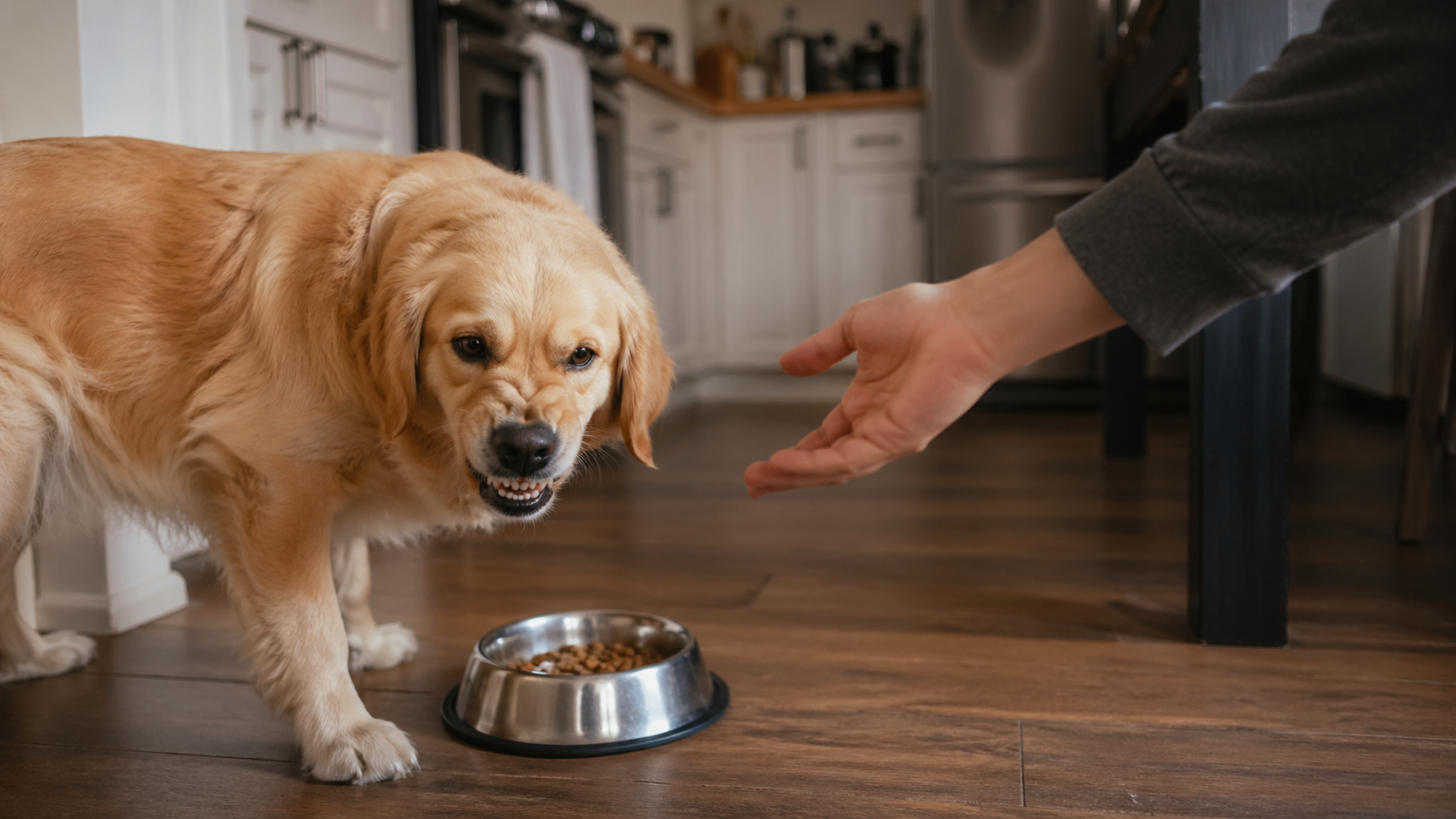
You’re standing near the bowl. Your dog is eating. You step closer—and suddenly there’s a snap.
This is dog snapping when approached while eating, and right now, you’re probably thinking: “My dog is being aggressive over food.”
No. That’s not what’s happening.
You’re walking into a guarded zone at the exact moment your dog feels most vulnerable.
And your timing—not your presence—is triggering the reaction.
Stop. Don’t move closer next time this happens. Because the next step you take is usually the one that triggers the snap.
Stay with me. I’m going to walk you through this like I’m right beside you. This type of reaction is often misunderstood and grouped with behaviors like dogs reacting aggressively toward visitors, even though the underlying trigger is completely different.
Trigger First: The Exact Moment It Breaks
Let’s freeze this in real time.
7:12 PM. Kitchen. Bowl hits the floor.
Your dog lowers its head. First bites. Everything is calm.
You take one step forward.
Now watch closely:
- Stimulus → your foot shifts forward
- Eyes → flick upward without moving the head
- Ears → rotate backward slightly
- Jaw → slows chewing for half a second
- Body → micro-freeze… almost invisible
- Weight → shifts forward over the bowl
- Tail → stiffens or stops moving
This is the moment.
You move again.
- Head lifts abruptly
- Lip curls
- Snap
No warning growl. No escalation. Just a fast correction.
Because from your dog’s perspective, you ignored the warning.
And here’s the reinforcement loop:
- You step back → pressure disappears
- Dog learns → snapping works
That’s how this locks in.
AHA Insight: The snap isn’t about food—it’s about controlling distance at the most sensitive moment.
Why This Is NOT General Aggression
This is where owners get it wrong.
You compare it to things like sudden aggression toward the owner or situations like being touched while sleeping.
But this is different. Completely different.
Food Guarding (What you’re seeing):
- Only happens during eating
- Triggered by approach, not touch
- Ends immediately when distance increases
- Highly predictable
General Aggression:
- Happens across multiple contexts
- Triggered by emotion (fear, frustration)
- Doesn’t switch off instantly
- Escalates unpredictably
Strong contrast:
This behavior is not your dog “turning on you.” It’s your dog protecting a resource in a moment where retreat feels impossible.
While this behavior is focused on food, similar escalation patterns can appear in other contexts. For example, some dogs show comparable defensive reactions when unfamiliar people enter their space, which is often linked to territorial visitor aggression rather than resource guarding.
How to Stop This BEFORE It Starts
This is the most important part. Forget stopping the snap—you prevent it before it exists.
The FIRST visible signal:
- Eye flick upward without head movement
- Chewing slows
- Ears rotate slightly back
This gives you a 1–2 second window.
This is the only moment you actually have control. Not after the snap. Not after the growl. Right here.
If you act here, the behavior never escalates.
If you miss it…
If you miss this moment, stopping the behavior becomes significantly harder.
Because once the body freezes, the dog is already committed.
What you must do in that window:
- Stop your forward motion immediately
- Shift your weight backward slightly
- Turn your torso 20–30 degrees sideways
This communicates: “I’m not a threat.”
8:03 PM. Feeding spot.
Your dog glances up.
You pause.
Within 1 second:
- Softly say: “Good”
- Toss a small treat 50 cm BEHIND the dog’s rear hip
Not near the bowl. Not in front.
Behind.
Because turning away from the bowl breaks guarding tension.
You are rewiring the moment before the snap ever forms. This same timing principle is critical in other fast-trigger behaviors like startle reactions during sleep, where early interruption changes everything.
Real-Time Action Script (Zero Ambiguity)
WHEN: The instant your dog’s eyes flick up
DO: Stop movement immediately
WHERE: Freeze in place, do not step forward
HOW FAR: Maintain at least 1 meter distance
WHY: Forward pressure triggers guarding
Within 1 second:
- Say “Good” in a calm tone
- Toss treat 40–60 cm behind the dog
- Keep shoulders angled away
WHY: You reward disengagement, not defense
IF dog returns to eating:
- Take one small step sideways
- Pause again
IF dog stiffens:
- Stop immediately
- Repeat the rear toss
If you move even half a step too late:
- The dog is already locked into guarding mode
- Your movement becomes pressure, not retreat
- The snap happens faster than your reaction
Precision Training Steps (Follow This Exactly)
Step 1 — Reset Distance
- Stand 1.5 meters away during feeding
- Observe only
- Do NOT approach
Step 2 — Controlled Approach
- Reduce distance slowly (10–15 cm per session)
- Pause after each step
- Watch for signals
Step 3 — Rear Toss Conditioning
- When dog looks up → toss behind immediately
- Distance: 40–60 cm
- Timing: within 1 second
Step 4 — Side Movement Only
- Walk at a 45° angle past the dog
- Keep 70–90 cm distance
- Do NOT face directly
Step 5 — Walk-By Neutralization
- Move past without stopping
- Drop treat behind occasionally
Step 6 — Exit Before Tension
- Leave while dog is still relaxed
- Do NOT wait for warning signals
Common Mistakes That Make It Worse
- Reaching toward the bowl
Dog learns: hands = threat - Standing over the dog
Dog feels trapped - Punishing the snap
Removes warning, not behavior - Testing repeatedly
Builds tension faster
Real Case: 2-Year-Old Labrador
Dog: Male Labrador, 2 years old
Issue: Snapping when owner approached during meals
Mistake: Repeated direct approach to “test behavior”
Correction:
- Reset distance to 1.5 meters
- Used rear-toss timing
- No direct approach for 5 days
Timeline:
- Day 3: no snapping
- Day 7: calm at 1 meter
- Day 14: safe walk-by
Conclusion: What You Do Next
Dog snapping when approached while eating is not random. It’s predictable and preventable.
The mistake isn’t walking near the food. The mistake is walking in at the wrong moment.
You don’t fix it by confronting it.
You fix it by controlling the moment before it happens.
Watch the eyes. Respect the freeze. Redirect the tension.
If you’re seeing similar intensity in other contexts, it’s worth comparing patterns like unexpected aggression shifts at home or reactivity toward guests to understand the difference in triggers.
Explore more behavior patterns in dog behavior guides.
Don’t step into the snap.
Control the second before it exists.