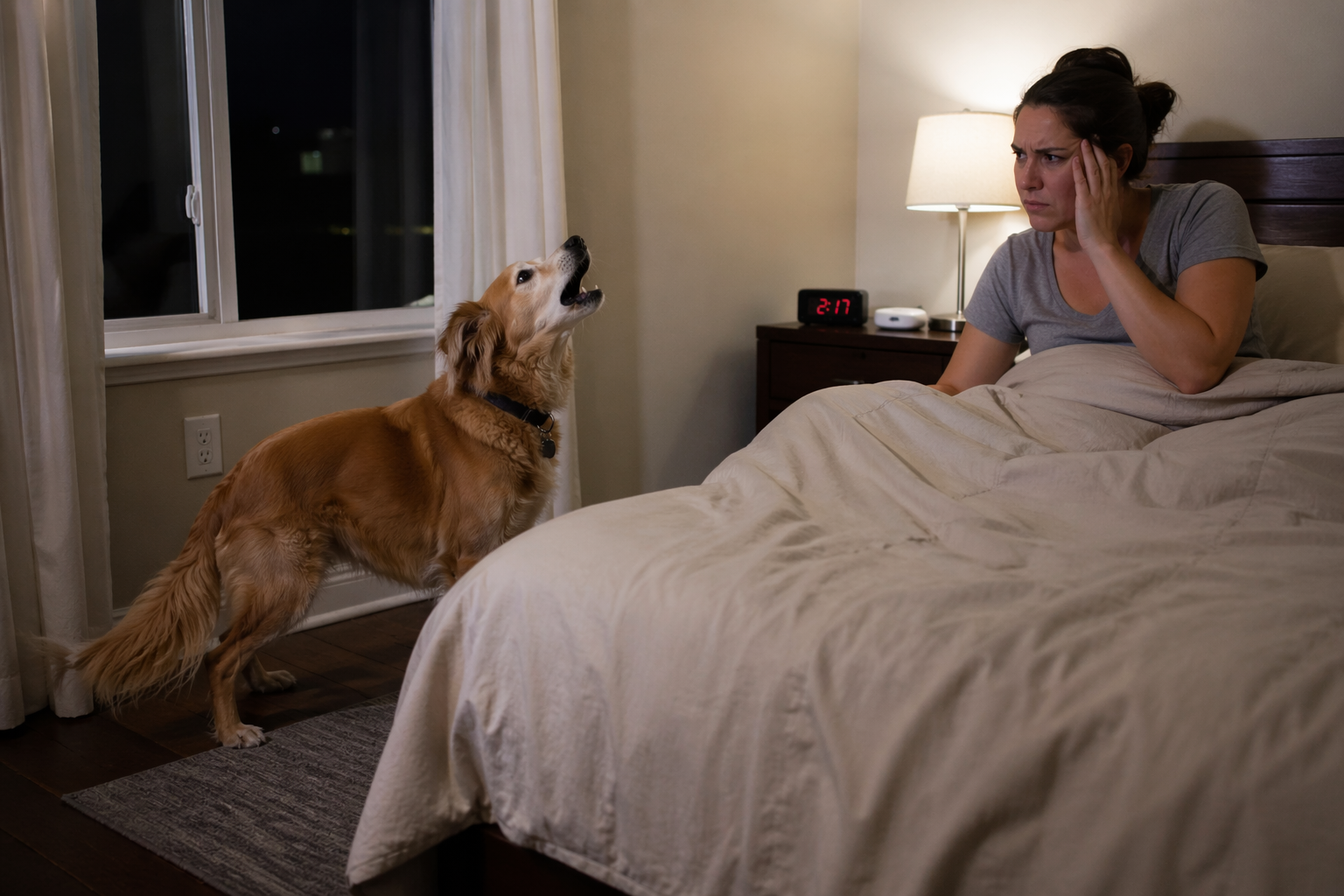
You’re standing in your house at 2:13 AM. Your dog suddenly explodes into barking. No visible trigger. No person outside. No noise you can hear. It feels like dog barking at night for no reason.
But I’m going to stop you right there.
This is not random. You’re just missing the first 2 seconds where everything starts.
Right now, I want you to stop thinking “why is my dog barking?” and start thinking:
“What did my dog notice before I did?”
What You Think vs What’s Actually Happening
You think: your dog is barking at nothing.
Reality: your dog detected a faint, distant stimulus (sound, vibration, or movement) and completed a full alert-response cycle before you even registered anything.
Why the confusion exists: human sensory delay. Dogs hear and process faster, especially at night when environmental noise drops.
First visible signal you’re missing: head lift + ear pivot.
Control moment: the 1–2 second window before the first bark.
AHA Insight: The bark isn’t the problem — it’s the result of a decision you didn’t interrupt.
The Exact Behavior Chain (Watch This Like Slow Motion)
Let’s replay what actually happens. You’ve seen this — just not in sequence.
2:18 AM — total silence.
Your dog is lying down. Breathing slow.
Stimulus (you miss this):
A distant motorbike, a gate click, a faint footstep outside your hearing range.
Ear movement (0.3 seconds):
One ear rotates sharply toward the sound. The other follows.
Eye activation (0.5 seconds):
Eyes open. Pupils widen. Head lifts 2–5 cm.
Micro-freeze (0.5–1 second):
Body goes still. Breathing pauses. This is the decision point.
Tension shift (1 second):
Weight shifts forward. Neck extends. Muscles tighten along shoulders.
Commitment (0.5 seconds):
Dog stands up or leans forward. Tail stiffens.
Action:
First bark — loud, sharp, directional.
Reinforcement loop:
- Sound disappears or moves away
- Dog believes: “I handled it”
- Confidence in barking increases
2:19 AM — now you wake up.
But the decision already happened.
Why This Is NOT Separation Anxiety Barking
This matters. If you mislabel this, you’ll train the wrong thing.
Night alert barking:
- Triggered by external stimulus
- Starts from stillness → alert → bark
- Body faces a direction (door, window)
- Stops when environment changes
Separation anxiety barking:
- Triggered by your absence
- Starts immediately after you leave
- Includes pacing, whining, destruction
- Does NOT depend on outside sounds
Sharp contrast:
Alert barking is about control of territory.
Separation anxiety is about panic over loss of access to you.
If your dog is silent until a specific moment at night — this is alert behavior, not emotional distress.
How to Stop Dog Barking at Night for No Reason BEFORE It Starts
This is the most important part. Everything hinges on this window.
First signal: ear pivot + head lift.
Your window: 1–5 seconds.
If you miss this moment, stopping the behavior becomes significantly harder.
2:21 AM — micro scenario:
Your dog is lying beside the bed.
Suddenly — ears snap forward.
THIS is your moment.
If you wait for barking, you are already too late.
What must happen instead:
- You interrupt the investigation phase
- You redirect the dog BEFORE it commits to alert mode
- You replace “scan → bark” with “scan → disengage”
Miss it — and your dog rehearses barking again.
Real-Time Action Script (Do This Exactly)
Moment: dog lifts head and ears rotate
Within 1 second:
- Say: “Hey” (soft, low tone — not sharp)
- DO NOT raise volume
Immediately (no delay):
- Toss a treat 40–60 cm BEHIND your dog
- Angle: slightly to the side, not straight back
Your body:
- Stay still
- Do NOT lean forward
- Do NOT look toward the trigger
Why this works:
- Breaks forward focus
- Forces full body disengagement
- Interrupts the alert chain before barking
If dog turns back to the trigger:
- Repeat once only
- Same direction, same distance
Consistency here rewires the pattern.
Precision Training Steps (Locked System)
We’re building control in the exact moment your dog decides to bark.
Step 1: Set the Night Environment
When: before sleep (10:30–11:30 PM)
Do: place 10–15 small treats within arm’s reach
Where: bedside table
Distance: reachable without standing
Do NOT: get up during response
Why: movement toward dog increases alert state
Scenario: 11:05 PM — lights off, your hand rests near treats, ready.
Step 2: Catch the Ear Movement
When: ear flick or head lift
Do: whisper “hey” within 1 second
Where: from your current position
Distance: no movement
Do NOT: say name loudly
Why: loud voice escalates alert mode
Scenario: 2:18 AM — ear snaps forward — you respond instantly.
Step 3: Redirect Physically
When: immediately after verbal cue
Do: toss treat behind dog
Where: 45 cm behind rear paws
Angle: 30° to left or right
Do NOT: throw toward trigger
Why: creates full body turn = disengagement
Scenario: Dog turns away from window instead of locking onto it.
Step 4: Freeze Your Body
When: after treat lands
Do: remain completely still
Where: bed or seated position
Distance: no approach
Do NOT: step toward dog
Why: movement = confirmation of “something’s happening”
Scenario: You become neutral background — tension drops.
Step 5: End the Loop Cleanly
When: dog finishes treat and pauses
Do: say nothing
Where: stay in place
Do NOT: praise excitedly
Why: calm = safe, excitement = alert continuation
Scenario: Dog settles instead of re-scanning.
Step 6: If Bark Happens Anyway
When: first bark occurs
Do: stay silent for 2 seconds
Then: toss treat behind (same 40–60 cm)
Do NOT: say “no” or shout
Why: punishment confirms threat
Scenario: Bark → pause → disengage instead of bark loop.
Real Case (What Actually Changed the Outcome)
Dog: 3-year-old mixed breed, medium size
Issue: barking nightly at 2–3 AM
Mistake owner made:
Waiting for barking, then yelling from bed.
What dog learned:
“Something is wrong — even my human reacts.”
Correction:
- Owner trained to watch for ear movement
- Used 50 cm backward treat toss
- No verbal escalation
Timeline:
- Night 1–2: barking reduced intensity
- Night 3–5: barking replaced with alert + disengage
- Night 7: no barking, only brief head lift
Common Mistakes That Make It Worse
1. Saying “NO” loudly
Why it fails: confirms threat
Dog learns: “We’re both reacting — danger is real”
2. Getting up and checking outside
Why it fails: reinforces alert investigation
Dog learns: “My bark triggered action”
3. Petting the dog immediately
Why it fails: rewards alert state
Dog learns: “Being tense brings attention”
4. Ignoring early signals
Why it fails: misses control window
Dog learns: “Scanning leads to barking”
If your dog shows multiple behavior patterns beyond nighttime barking, you can explore more step-by-step solutions in our dog behavior guides to understand the bigger picture.
Conclusion: You’re Not Stopping Barking — You’re Replacing a Decision
What feels like dog barking at night for no reason is actually a fast, silent chain you’ve been missing.
You don’t fix this by reacting to barking.
You fix it by intercepting the moment your dog decides to bark.
Catch the ears. Interrupt the focus. Redirect the body.
Do that consistently — and the barking disappears without force.