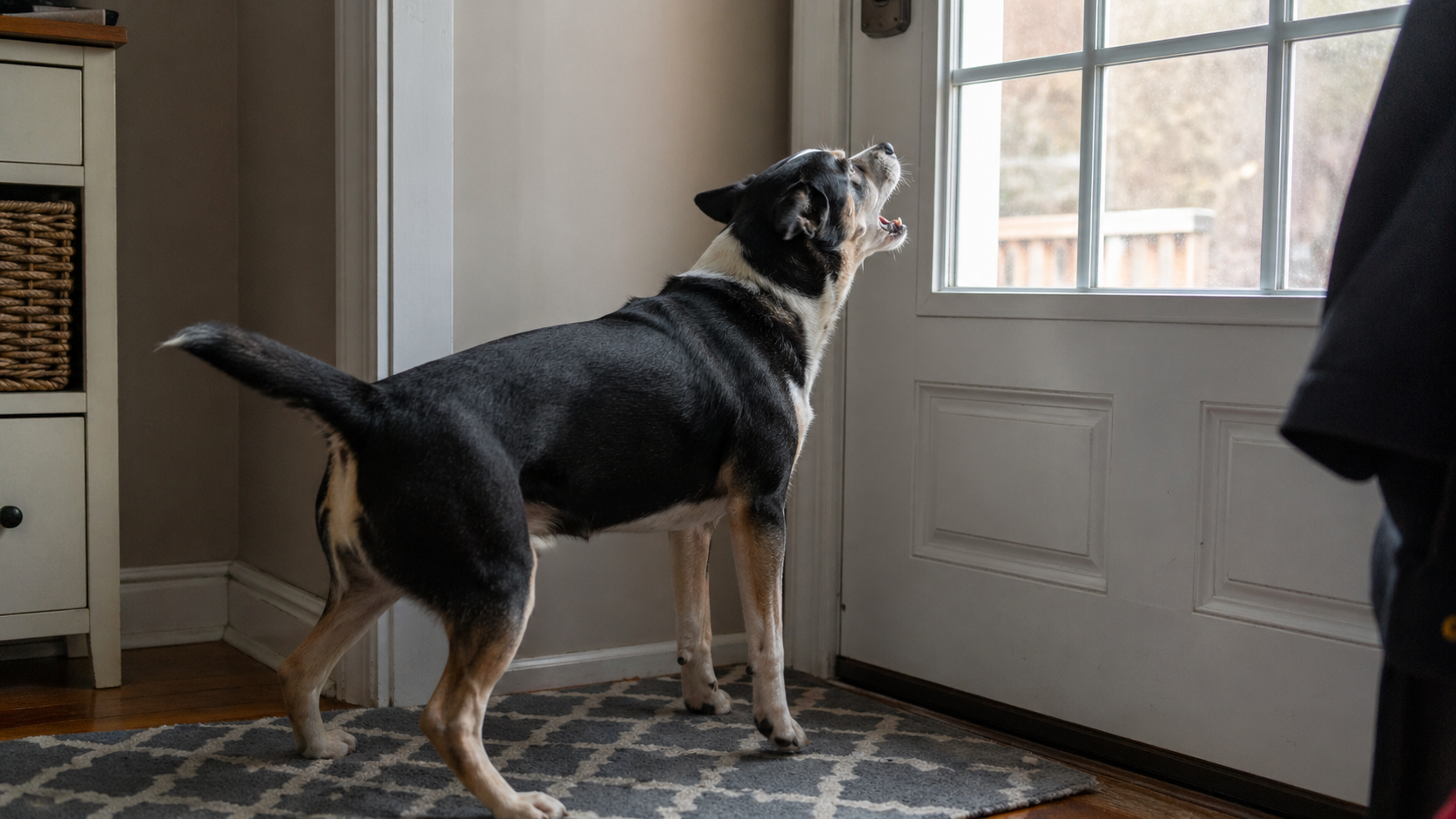
You leave the house… and within seconds, your dog starts crying.
Not barking. Not pacing. Crying.
Most owners think this starts after they leave.
It doesn’t.
It started 10 seconds earlier—and you missed it.
You’re not dealing with random noise. When your dog cries when left alone, what you’re seeing is a very specific attachment loop firing the moment you break proximity.
Right now, I want you to picture this clearly: your dog is not “being dramatic.” It’s reacting to a predicted loss of access to you — and that prediction starts before you even leave.
We’re going to catch it earlier than you ever have before. In some cases, owners confuse this with situations like puppies barking in a crate at night, but the underlying trigger and timing are completely different.
Quick Check — This is your situation if:
- Your dog reacts the moment you grab keys, shoes, or your bag
- It follows you closely before you even reach the door
- The crying starts within seconds of you touching the door
Trigger Breakdown — The Exact Moment Your Dog Cries When Left Alone
This is a trigger-based behavior. It is not about being alone. It is about the moment your dog realizes you’re about to leave.
Let me walk you through it in slow motion.
Stimulus: You pick up your keys at 7:42 AM.
Eyes: Your dog’s eyes snap toward your hand — not your face.
Ears: Ears tilt forward, slight tension.
Micro-freeze (less than 1 second): Body stops moving. This is the prediction moment.
Tension shift: Weight shifts forward, neck extends, breathing changes.
Action: Your dog follows you closely — closer than usual.
Reinforcement: You either:
→ talk to the dog
→ look at the dog
→ pet the dog
Now the loop locks in.
7:41:58 AM — your dog is lying down.
7:42:01 AM — you pick up your keys.
7:42:02 AM — head lifts. Eyes lock.
7:42:03 AM — body freezes.
This is the moment everything changes.
By the time you reach the door?
The crying is already inevitable.
At 7:43 AM: You touch the doorknob.
At 7:43:02: First whine.
At 7:43:05: High-pitched cry or bark.
That sound isn’t random. It’s the final release of pressure that started building 10–20 seconds earlier.
If this repeats often, your dog will start reacting earlier and earlier—even when you simply stand up or move across the room.
AHA INSIGHT:
The crying doesn’t start when you leave — it starts when your dog predicts you will.
Why This Is NOT Barking When Left Alone
This is where people get it wrong.
When a dog barks when left alone, the behavior often happens after separation, usually tied to boredom, alertness, or environment.
But when a dog cries when left alone?
This is attachment-driven and pre-exit focused.
Let’s make this crystal clear:
Attachment crying:
→ Starts BEFORE you leave
→ Triggered by your movements
→ Dog tracks your body closely
→ Emotional tone = distress + urgency
Typical barking when alone:
→ Starts AFTER you leave
→ Triggered by sounds or boredom
→ Dog disengages from door after a while
→ Emotional tone = alert or restless
Micro-scenario (6:10 PM):
You grab your bag.
Your dog stands up instantly and shadows you step-for-step.
That reaction is already too early to be “being alone.”
That’s not boredom.
That’s dependency.
This behavior is about losing you — not being alone.
If you train it like barking, you will fail.
For comparison, see how this differs from dog barking when left alone, where the trigger happens after separation, not before.
How to Stop This BEFORE It Starts
This is your control point. Miss this, and everything becomes harder.
The first signal is subtle:
→ Your dog stops what it’s doing and locks onto your movement
This happens within 1–2 seconds of your pre-leaving cue (keys, shoes, bag).
At 7:41:50 AM, your dog is relaxed.
At 7:42:00 AM, you pick up keys.
At 7:42:01 AM, your dog freezes and stares.
This is the moment.
If you act here, the crying never builds.
If you miss it?
The emotional chain continues and escalates into vocalization.
Say this out loud to yourself:
“Freeze → focus → follow → cry.”
You are interrupting at freeze.
If you miss this moment, stopping the behavior becomes significantly harder.
Real-Time Action Script (Do This Exactly)
We’re going to run this like a drill.
Scenario: 7:42 AM — You pick up your keys.
Step 1 — WHEN: The instant your dog looks at your hand (within 1 second)
DO: Say “Good” softly, calm tone
WHERE: Keep your body angled about 30° away from your dog
HOW FAR: Maintain at least 1 meter distance
WHY: You mark awareness without inviting attachment
Step 2 — IMMEDIATELY:
DO: Toss a treat 50–70 cm BEHIND your dog
WHERE: Slightly to the side, not directly back
WHY: Forces full disengagement and body turn
Step 3 — AS DOG MOVES:
DO: Stay completely still
WHAT NOT TO DO: No eye contact, no talking
WHY: Prevents reattachment loop
Step 4 — WHEN DOG FINISHES TREAT:
DO: Take one step toward the door (30–40 cm)
WHERE: Keep shoulders slightly angled away from your dog
HOW: Move slowly — one step every 2 seconds
WHY: Keeps arousal low while continuing departure
Step 5 — IF DOG RE-ENGAGES:
DO: Repeat treat toss behind at same distance
LIMIT: Max 3 repetitions
WHY: Builds pattern: your movement = disengage, not follow
This must feel mechanical. No improvising.
Precision Training Steps (Follow in Order)
Step 1 — Break the Prediction Pattern
At 6:30 PM, pick up your keys — then sit down again within 2 seconds.
Stand near the door but do not leave.
Repeat 5–6 times per session.
Body position: Stay upright, neutral posture
Distance: Stay at least 1.5 meters from dog
What NOT to do: Don’t look at your dog after picking keys
Why: You remove the certainty of departure
Micro-scenario:
At 6:32 PM, your dog watches you grab keys… then relaxes when nothing happens.
Step 2 — Controlled Movement Toward Exit
Timing: One step every 2–3 seconds
Distance: Each step about 30–40 cm
If your dog stands up:
→ stop immediately
→ wait 2 seconds
→ toss treat 60 cm behind
What NOT to do: Do not continue walking if dog is following
Why: Movement must not trigger pursuit
Micro-scenario:
8:05 AM — you take two steps.
Dog rises.
You pause.
Dog settles.
You continue.
Step 3 — Door Interaction Without Exit
Touch the doorknob.
Timing: Hold for 3 seconds
If dog tenses:
→ immediately toss treat behind (50 cm)
Repeat 6–8 times.
What NOT to do: Don’t open the door yet
Why: Removes emotional spike tied to the door
Micro-scenario:
7:10 AM — your dog hears the door click… but doesn’t react anymore.
Step 4 — Micro-Exits (Critical Phase)
Open door and step outside for 2 seconds only.
Distance: One step outside (60–80 cm)
Return before your dog vocalizes.
If crying starts:
→ you stayed out too long
What NOT to do: Don’t wait for silence before returning
Why: You train tolerance, not endurance
Micro-scenario:
9:00 AM — you step out and back in before your dog reacts.
Zero crying.
Step 5 — Build Duration Gradually
Increase absence time in this order:
2 sec → 5 sec → 10 sec → 20 sec → 45 sec
Only increase if: No crying occurred
What NOT to do: Don’t jump from 5 seconds to 1 minute
Why: Prevents emotional overload
Micro-scenario:
Day 3: calm at 20 seconds.
Day 5: reaches 45 seconds quietly.
Step 6 — Remove Pre-Exit Attention
10 minutes before leaving:
→ no talking
→ no touching
→ no eye contact
Position: Move neutrally around the house
Why: Prevents emotional buildup
Micro-scenario:
7:30 AM — you ignore your dog completely.
7:40 AM — your dog stays relaxed.
Common Mistakes That Make Crying Worse
1. Talking before leaving
You say “I’ll be back.”
→ Dog hears emotional cue
→ Anxiety spikes
→ Crying starts earlier next time
2. Petting when dog follows
You reward attachment behavior
→ Dog learns: following = connection
→ Increases dependency
3. Leaving too slowly without structure
You hesitate randomly
→ Dog becomes hyper-focused
→ Builds tension instead of reducing it
4. Ignoring early signals
You wait until crying starts
→ You’re already too late
→ Behavior fully activated
Real Case — 2-Year-Old Mixed Breed
Dog: 2-year-old rescue, high attachment
Problem: crying starts within 5 seconds of picking keys
Mistake: owner gave attention before leaving
Correction: removed pre-exit interaction + added disengagement timing
Timeline:
Day 2 → crying delayed
Day 4 → no crying at door
Day 7 → calm up to 1 minute alone
Key shift:
The dog stopped predicting separation as a threat.
Conclusion
If your dog cries when left alone, the solution is not teaching independence after you leave.
It’s controlling the moment your dog realizes you’re about to go.
Catch the freeze.
Interrupt the focus.
Break the follow.
Your dog isn’t afraid of being alone.
It’s reacting to losing you before you leave.
Fix that moment—and the crying disappears before it even begins.
For broader behavior patterns, explore dog behavior guides or compare with dog barking when left alone to understand different trigger types.