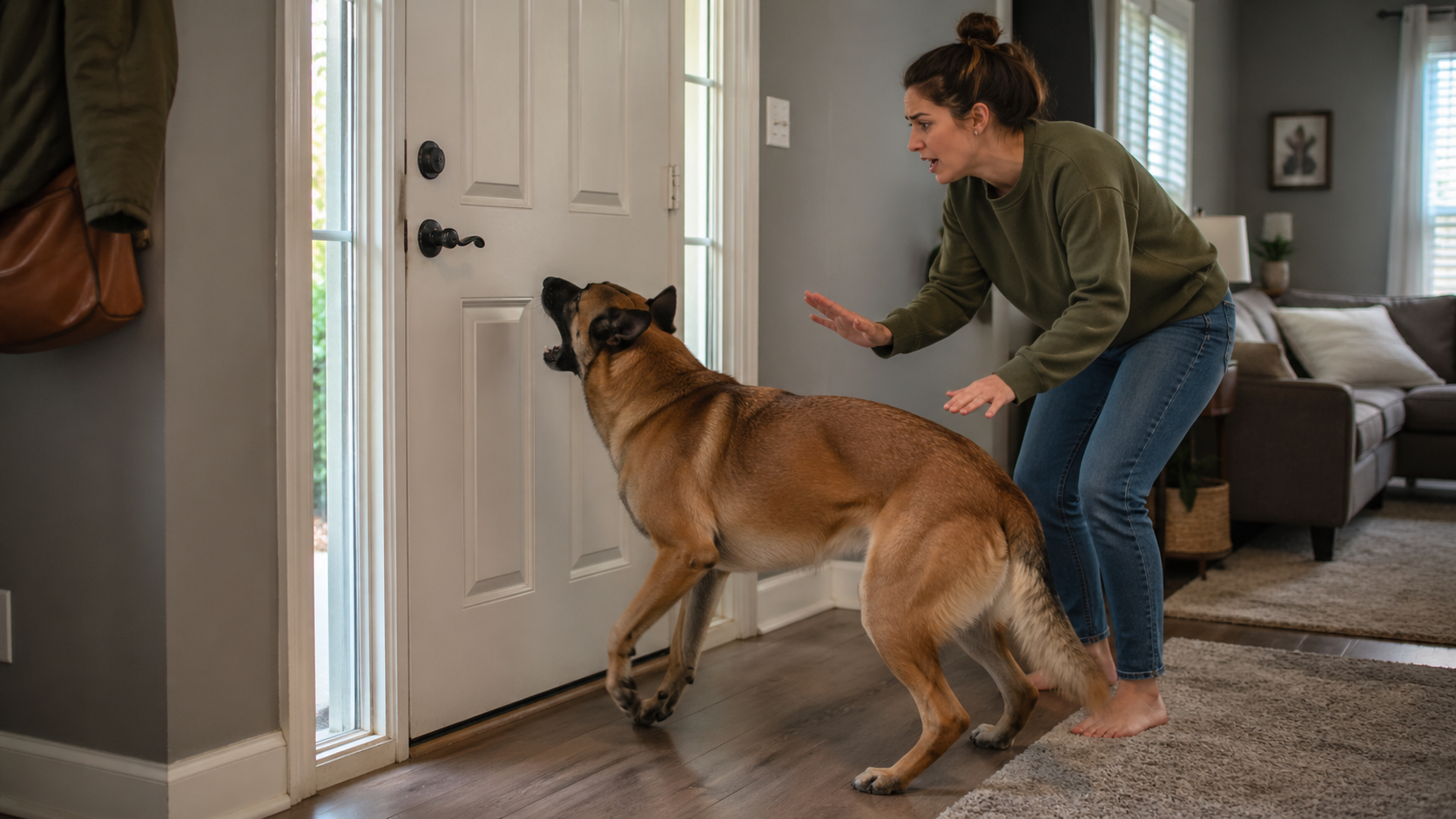
The doorbell rings—and within seconds your dog explodes at the visitor.
Most owners think this is aggression.
It’s not.
And the mistake you make in the next 3 seconds is exactly what makes it worse.
You’re standing in your living room. The doorbell rings. Your dog stiffens, rushes forward, and suddenly you’ve got barking, lunging, maybe even snapping at your visitor.
You’re thinking: “My dog is aggressive toward visitors.”
What’s actually happening is much more specific—and fixable.
This is territorial pressure building before the visitor even fully enters your space. Your dog isn’t randomly aggressive. It’s reacting to a very precise moment you’re currently missing.
We’re going to slow this down and fix it in real time.
Quick Check — This is exactly your situation if:
- Your dog reacts the moment someone approaches the door
- The behavior is stronger inside your home than outside
- Your dog seems to take control before you even move
Trigger Moment: The Exact Second Your Dog Decides the Visitor Is a Threat
Forget the barking for a second. That’s not the beginning.
The real trigger happens before the door even opens.
Watch closely next time:
Stimulus → Sound of footsteps outside or doorbell vibration
→ Ears snap forward instantly
→ Eyes lock toward the door (not moving, just staring)
→ Micro-freeze in the shoulders (0.5–1 second)
→ Weight shifts forward onto front paws
→ Tail stiffens (not wagging loosely—tight, controlled)
→ Breath shortens
→ THEN barking explodes forward movement
That micro-freeze is the decision point.
That’s when your dog is saying: “Something is entering my space. I need to control it.”
And here’s the part most owners miss:
You’re usually still walking toward the door… completely unaware that your dog has already escalated internally.
By the time barking starts, the behavior is already in motion.
The barking works because:
→ Visitor pauses or hesitates
→ You react (talking, grabbing, tension)
→ Dog feels its action influenced the situation
That’s reinforcement.
If this repeats often, your dog will start taking control earlier and earlier—before you even realize what’s happening.
AHA INSIGHT:
Your dog isn’t reacting to the visitor—it’s reacting to the moment it feels responsible for the space.
Why This Is NOT Just “Barking at Strangers”
This is where people confuse things.
You might think this is the same as a dog that barks at strangers on walks or outside the house.
It’s not.
Micro-scenario (8:05 PM):
A visitor steps into your home.
Your dog stiffens instantly—much faster than it would outside.
That speed is the difference.
Here’s the difference:
Dog aggressive towards visitors (THIS case):
→ Happens inside your home territory
→ Trigger = entry into controlled space
→ Dog feels ownership + responsibility
→ Behavior escalates faster and stronger
Dog barking at strangers outside:
→ Happens in neutral or shared space
→ Trigger = unfamiliar movement
→ Dog feels alert, not in control
→ Easier to redirect
In your situation, your dog believes:
“If I don’t act, no one will control this.”
That’s why it’s more intense.
This is also different from what you’ll see in dogs that bark at strangers but not guests, where familiarity changes the response.
Here, the issue is not familiarity—it’s entry control.
How to Stop This BEFORE It Starts
This is the most important part. If you get this right, you won’t need to “fix” aggression—you’ll prevent it.
The first visible signal:
Ear snap + eye lock toward the door.
This gives you a 1–3 second window.
That’s it.
Inside that window:
Your dog is still thinking.
Not reacting yet.
If you miss it?
The body locks, adrenaline spikes, and the bark/lunge sequence begins.
If you miss this moment, stopping the behavior becomes significantly harder.
What you must do in that window:
Interrupt the forward intention—not the bark.
Because once barking starts, the brain is no longer processing calmly.
This same early-trigger pattern also appears in situations like dog snapping when eating and even sudden escalation cases such as dog suddenly aggressive towards owner, where missing the first signal makes the behavior feel unpredictable.
Micro-scenario (6:42 PM):
You hear footsteps outside your gate.
Your dog’s ears snap forward.
You are still 2 meters from the door.
This is your moment.
Not when barking starts.
Now.
2:18 PM, delivery arrives.
Before the knock even finishes,
your dog freezes and leans forward.
That lean is your cue.
If you wait for noise—you’re late.
Real-Time Action Script (Do This Exactly)
We’re going to run this like a drill.
WHEN: The instant your dog’s ears snap toward the door
DO: Say “Here” in a calm, low tone (not loud)
WHERE: Stand still—do NOT move toward the door yet
HOW FAR: Toss a treat 50–70 cm BEHIND your dog, slightly angled away from the door
WHY: This forces a full body disengagement, not just head turning
Next step immediately:
WHEN: Dog turns to get the treat
DO: Take one step sideways (not forward)
WHERE: Move 30–50 cm away from the door path
WHY: You remove pressure and block direct line to the door
Next:
WHEN: Dog finishes treat and looks back
DO: Drop another treat slightly behind you (not toward door)
HOW FAR: 40 cm behind your heel
WHY: You’re building a pattern: door sound = move away, not forward
Micro-scenario (7:12 PM):
Doorbell rings.
Your dog turns back instead of charging.
That moment changes everything.
CRITICAL RULE:
Do NOT:
→ Walk toward the door while the dog is still focused on it
→ Grab the collar
→ Say “No” or shout
That adds tension and confirms the threat. Similar pressure-based mistakes can also trigger reactions like dog growling when touched while sleeping, where the dog reacts because it feels suddenly threatened.
Precision Training Steps (Repeat This Exactly)
Step 1 — Pre-Position Before the Trigger
WHEN: You expect a visitor (1–2 minutes before arrival)
DO: Stand 1.5–2 meters away from the door
WHERE: Position yourself slightly between dog and door (not blocking fully)
WHAT NOT TO DO: Don’t hover directly over the dog
WHY: You’re controlling space without creating pressure
Scenario (5:55 PM):
You know someone is arriving.
You’re already in position.
Dog is relaxed—but alert.
Step 2 — Catch the First Signal
WHEN: Ear movement or head turn toward door
DO: Say “Here” softly within 1 second
WHERE: Keep shoulders neutral, no leaning forward
HOW FAR: Toss treat 60 cm behind dog
WHAT NOT TO DO: Don’t repeat the cue multiple times
WHY: Timing teaches the dog what matters—not volume
Step 3 — Redirect Movement Path
WHEN: Dog turns for treat
DO: Step diagonally sideways 40 cm
WHERE: Away from door line
WHAT NOT TO DO: Don’t step toward dog or door
WHY: You change geometry of movement—this reduces pressure buildup
Step 4 — Build the Pattern Before Opening Door
WHEN: Dog reorients to door again
DO: Repeat treat toss behind (50 cm)
HOW FAR: Alternate left/right sides slightly
WHAT NOT TO DO: Don’t open the door yet
WHY: You are rewriting the sequence: sound → disengage → reward
Step 5 — Controlled Door Opening
WHEN: Dog stays disengaged for 3–5 seconds
DO: Slowly reach for handle
WHERE: Keep body angled between dog and door
WHAT NOT TO DO: Don’t swing door open fully
WHY: Sudden opening spikes arousal
Scenario (6:03 PM):
You open door 10 cm.
Dog glances—but doesn’t lunge.
That’s control.
Step 6 — Visitor Entry Management
WHEN: Visitor steps inside
DO: Ask them to ignore the dog completely
WHERE: Guide dog 1–2 meters away using treat placement
WHAT NOT TO DO: Don’t allow direct approach or eye contact
WHY: Interaction too early triggers escalation
Real Case Scenario
Golden Retriever, 3 years old.
Owner complaint: “He’s suddenly aggressive toward visitors.”
Reality:
Dog began controlling the doorway after repeated reinforcement:
→ Bark → visitor pauses → owner restrains → tension increases
We changed one thing:
Timing.
Owner learned to interrupt at ear movement stage.
Within 5 days:
→ Barking reduced by 60%
→ Lunging stopped completely
→ Dog began moving away from door automatically
No punishment. Just timing and positioning.
Common Mistakes (And What Your Dog Learns)
1. Opening the door while the dog is focused
Why it fails: Confirms the threat is real
Dog learns: “I was right to react”
2. Holding the collar tightly
Why it fails: Adds physical tension
Dog learns: “Something serious is happening”
3. Yelling “No!”
Why it fails: Increases arousal
Dog learns: “This situation is intense”
4. Letting the visitor greet the dog immediately
Why it fails: Overloads the dog
Dog learns: “I must control this interaction”
Micro-scenario (8:47 PM):
Visitor reaches down to pet your dog.
Your dog stiffens again instantly.
This is escalation restarting.
Final Correction
If your dog is aggressive towards visitors, stop trying to control the reaction.
Control the moment before the reaction.
Watch the ears. Watch the eyes.
Act in the first second.
Your dog doesn’t need control of the door.
It needs to see that you already have it.
For broader behavior patterns, see dog behavior guides or explore related escalation patterns like night barking triggers.