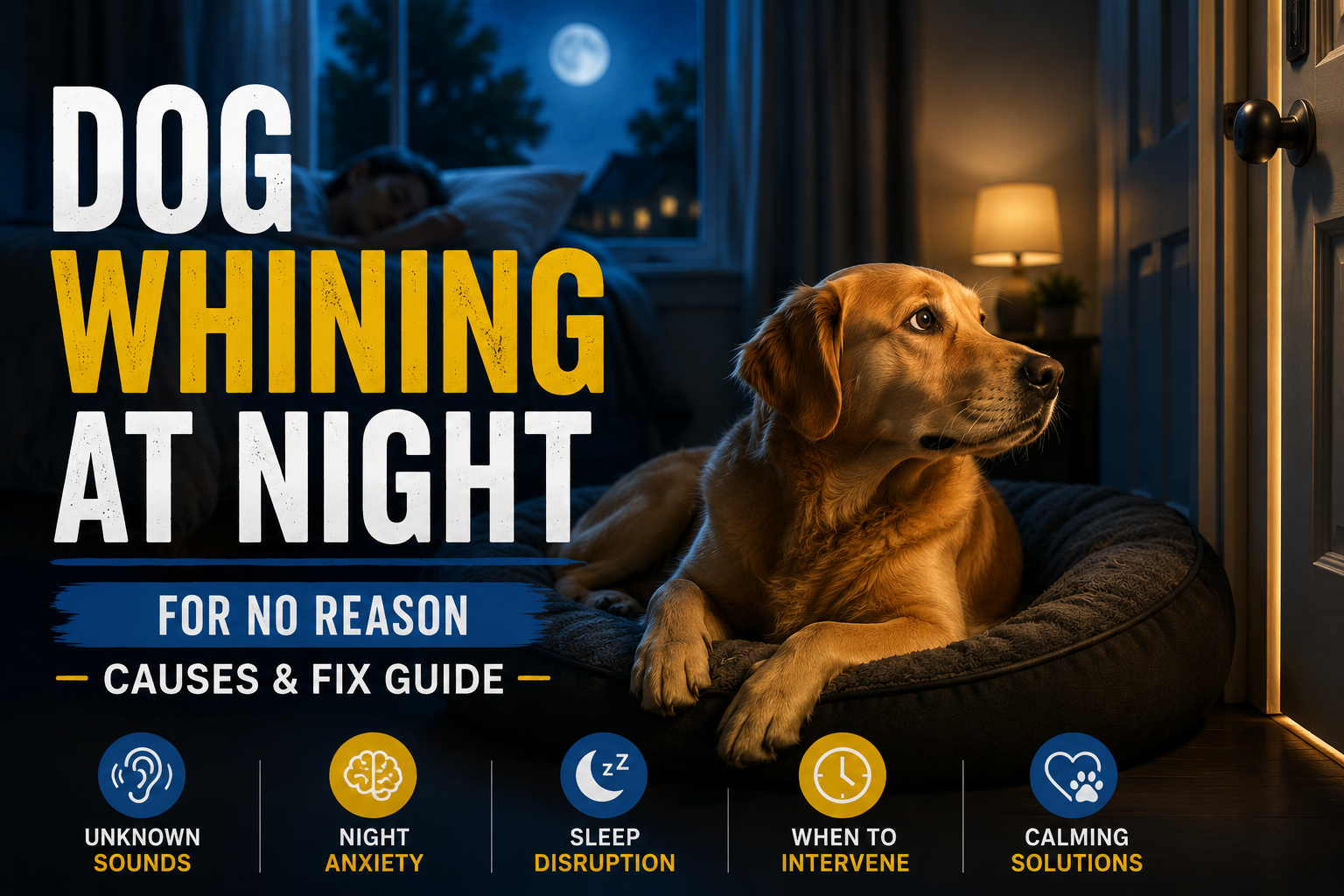
It’s 2:17 a.m. The house is completely quiet. The lights have been off for hours, and everyone is asleep. Then you hear it—a soft whine from another room.
You pause, listening.
A few seconds later, it happens again.
Your dog isn’t barking. He isn’t scratching at the door. He isn’t running around the house. He’s simply whining, and as far as you can tell, nothing triggered it.
Many owners assume this behavior appears without warning. It feels random because the whining is the first thing they notice.
But if you quietly watched your dog for the minute before the first whine, you would often see a completely different story unfolding.
Instead of focusing on the sound, watch your dog’s body.
Notice where he’s looking.
Watch how often he shifts his weight.
Look at the position of his ears.
Pay attention to how his breathing changes.
The important moment usually happens several seconds before the first whine ever leaves his mouth.
Nighttime Whining Usually Begins with a Small Change in Emotion
Dogs rarely wake up and suddenly decide to whine.
Something changes first.
At night, those changes are often subtle because the environment becomes much quieter. Sounds that were hidden during the day suddenly become noticeable. Familiar family routines disappear. Shadows look different. Even the absence of movement can make some dogs more aware of their surroundings.
Your dog may hear a distant car door.
He may notice someone walking outside.
He may wake between sleep cycles and realize the house feels unusually quiet.
None of these events automatically cause whining.
They simply begin an emotional chain that many owners never see.
Watch the Emotional Chain Before the Whining Starts
Imagine your dog lying comfortably in his bed.
Everything appears normal.
Then a faint sound comes from outside.
Instead of whining immediately, he usually progresses through several visible body-language changes.
- His eyes open wider.
- His ears rotate toward the sound.
- His breathing becomes slightly faster.
- His head lifts.
- His body becomes still instead of relaxed.
- He pauses as if waiting for more information.
Only after these changes continue does he make a decision.
If the uncertainty grows, the first quiet whine often follows.
The whining isn’t the beginning of the problem.
It’s simply the first behavior you can hear.
If Nothing Changes, Here’s What Usually Happens Next
Learning to predict your dog’s next move is far more useful than reacting after the whining has already become intense.
Suppose you notice your dog’s ears remain pointed toward the bedroom door for several seconds.
If nothing changes, you may soon notice him shifting his weight forward instead of lying comfortably.
If that uncertainty continues, he may begin scanning the room with quick eye movements.
The emotion often changes from simple awareness to mild concern.
Once that concern grows, many dogs make the decision to vocalize.
The first whine is usually soft.
If no new information reassures the dog, the whining may become more frequent, louder, or develop into pacing.
Recognizing this sequence gives you something valuable.
Instead of wondering why your dog suddenly started whining, you begin noticing that the decision was developing long before you heard it.
Understanding the Emotional Progression
Although every dog is different, nighttime whining often follows a predictable emotional pathway.
Relaxed
Your dog is resting comfortably. His muscles appear loose, his breathing is steady, and he settles naturally after changing positions.
Aware
A small sound or environmental change catches his attention. His ears move before the rest of his body does.
Unsure
He keeps watching the same location. His breathing changes slightly, and his body becomes noticeably still.
Concerned
He begins sitting up, repeatedly looking toward the same direction, or waiting for another sound.
Reactive
The uncertainty becomes uncomfortable enough that whining starts as an attempt to seek information, reassurance, or social contact.
Understanding these stages helps explain why nighttime whining often feels unpredictable.
The behavior isn’t appearing from nowhere.
It’s growing quietly through emotions that are easy to miss if you’re only listening for the sound.
Reading Your Dog: What Small Changes Often Mean
| What You See | What It Usually Means |
|---|---|
| Ears suddenly turn toward one direction | Your dog has detected something before you have. |
| Head slowly lifts while resting | Attention has shifted away from sleep. |
| Breathing becomes slightly quicker | Alertness is increasing. |
| Body becomes unusually still | Your dog is gathering information before deciding what to do. |
| Repeated glances toward a doorway or window | The source of uncertainty remains unresolved. |
| Small, quiet whine without movement | The emotional discomfort has become strong enough to communicate. |
Notice that every observation appears before more obvious behaviors like persistent whining, barking, or pacing.
Those earlier signals are where experienced dog owners focus their attention.
If your dog’s nighttime vocalizing becomes louder after these early warning signs, our guide on dog barking at night for no reason can help you compare whether the underlying trigger is progressing from uncertainty into full alert behavior.
How to Stop Nighttime Whining Before It Starts
By the time your dog has been whining for several minutes, you’re already working against a much stronger emotional state.
The easier opportunity comes much earlier.
The best intervention window is usually within one to five seconds after the first noticeable body-language change—not after the whining begins.
Watch for the earliest signs you learned in the previous section.
- The ears suddenly point toward a doorway.
- The head lifts from the bed.
- The body becomes still.
- The breathing changes.
- The eyes remain fixed on one area.
These are often the first visible clues that your dog’s emotional state is changing.
If you miss this moment, stopping the behavior becomes significantly harder.
Your goal is not to silence the whining.
Your goal is to prevent the uncertainty from becoming strong enough that whining feels necessary.
Real-Time Coaching: What to Do During the First Five Seconds
Situation: Your dog suddenly becomes alert while resting.
WHEN
The moment your dog’s ears rotate toward a sound and his body becomes noticeably still.
WHAT YOU SEE
He lifts his head, watches one direction, and pauses instead of relaxing again.
DO
Wait one or two seconds before responding. If he remains tense, calmly acknowledge him with a soft voice instead of rushing across the room.
POSITION
Stand slightly to the side rather than directly in front of him.
DISTANCE
Remain about 4–6 feet (1–2 meters) away unless he approaches you first.
BODY POSTURE
Keep your shoulders relaxed, avoid leaning over him, and move slowly.
VOICE
Speak quietly using a slow, even tone. One short reassurance is usually enough.
WHY
Calm, predictable behavior provides new information that the environment is still safe. Your relaxed movements help prevent your dog from interpreting your reaction as confirmation that something is wrong.
EXPECTED RESPONSE
Many dogs briefly look toward you, soften their body posture, sigh, and return to resting if the uncertainty fades.
Behavior Decision Tree
Use this simple guide to narrow down what your dog’s nighttime whining may actually be communicating.
- Does the whining happen only at night?
- Yes → Continue observing the nighttime environment.
- No → The trigger may not be related to nighttime routines.
- Did you notice body-language changes before the whining?
- Yes → Emotional uncertainty likely developed first.
- No → Begin watching earlier next time instead of waiting for the sound.
- Does your dog settle after calm reassurance?
- Yes → Temporary uncertainty may have been the trigger.
- No → Continue observing for recurring patterns such as specific sounds, locations, or times.
- Is the whining becoming more frequent each night?
- Yes → Keep a detailed observation record and discuss persistent changes with your veterinarian or a qualified behavior professional.
- No → Continue reinforcing calm nighttime routines.
Nighttime Observation Checklist
Before trying to change the behavior, spend several nights collecting simple observations.
- □ What time did the first body-language change appear?
- □ What sound or event happened just before it?
- □ How far away was the possible trigger?
- □ Was the room completely dark, dimly lit, or illuminated?
- □ What was the very first body-language signal?
- □ How long did it take your dog to relax again?
- □ How did you respond?
Patterns often become much clearer after several nights of observation.
Instead of assuming your dog is whining “for no reason,” you’ll begin noticing that the same trigger, the same body-language sequence, and the same emotional progression occur repeatedly.
Progressive Nighttime Training Plan
Step 1: Learn the Earliest Warning Signs
Goal
Recognize the first body-language change before whining begins.
Timing
Observe quietly during your dog’s usual sleeping hours.
Owner Position
Remain seated or standing nearby without staring directly at your dog.
Distance
Approximately 6–10 feet (2–3 meters).
Movement Direction
Avoid moving toward your dog unless necessary.
Common Mistake
Waiting until the whining starts before paying attention.
Expected Dog Response
Your dog behaves naturally because he doesn’t feel watched or pressured.
Why It Works
You begin identifying the emotional shift before it becomes a behavioral problem.
Mini Real-Life Scenario
Around midnight, your dog quietly lifts his head toward the hallway but settles back down within seconds. You now recognize this as the earliest stage instead of missing it completely.
Step 2: Reinforce Calm Before Vocalizing
Goal
Help your dog return to relaxation while he is still quiet.
Timing
Within one to five seconds after the first alert body-language signal.
Owner Position
Stay beside the doorway or slightly to one side.
Distance
About 4–6 feet (1–2 meters).
Movement Direction
Move slowly in a gentle arc rather than directly toward your dog.
Common Mistake
Walking quickly toward your dog immediately after he notices something.
Expected Dog Response
He briefly checks in with you before relaxing again.
Why It Works
Your calm presence interrupts the emotional escalation before whining becomes the chosen response.
Mini Real-Life Scenario
Your dog hears a noise outside, glances toward the window, then looks back at you after your quiet reassurance. Within moments, he curls back into his bed.
Step 3: Build a Predictable Bedtime Routine
Goal
Reduce uncertainty by making every evening feel familiar and predictable.
Timing
Begin 20–30 minutes before bedtime every night.
Owner Position
Stay close enough to guide the routine without constantly interacting.
Distance
Allow your dog to choose a comfortable resting space nearby.
Movement Direction
Keep household activity calm and consistent as bedtime approaches.
Common Mistake
Having a different bedtime routine every night.
Expected Dog Response
Your dog begins settling more quickly because he can predict what happens next.
Why It Works
Predictability lowers unnecessary uncertainty, making nighttime transitions easier for many dogs.
Mini Real-Life Scenario
After several evenings of following the same quiet routine, your dog walks to his sleeping area on his own and settles before the lights are turned off.
Step 4: Gradually Increase Your Dog’s Confidence at Night
Goal
Help your dog remain relaxed when normal nighttime sounds occur.
Timing
Practice during calm evenings before your dog becomes worried.
Owner Position
Remain seated nearby so your presence feels predictable rather than reactive.
Distance
About 6–10 feet (2–3 meters), allowing your dog to choose whether to stay in his resting place.
Movement Direction
Avoid repeatedly checking windows or doors every time a small sound occurs.
Common Mistake
Reacting dramatically to every outside noise, which teaches the dog that those sounds deserve concern.
Expected Dog Response
He notices the sound, briefly investigates, then settles more quickly than before.
Why It Works
Dogs often take emotional cues from the people around them. Calm, predictable reactions make unfamiliar nighttime noises seem less important.
Mini Real-Life Scenario
A car door closes outside. Your dog lifts his head for a moment, sees that everyone remains relaxed, and returns to sleep without whining.
Step 5: Reinforce Quiet Relaxation
Goal
Increase the likelihood that calm resting becomes your dog’s default nighttime behavior.
Timing
Reward naturally calm behavior before whining begins.
Owner Position
Approach casually without making the interaction exciting.
Distance
Close enough to quietly praise or offer gentle affection if your dog enjoys it.
Movement Direction
Move slowly and leave calmly once your dog settles again.
Common Mistake
Giving attention only after whining starts.
Expected Dog Response
Your dog increasingly associates nighttime relaxation with positive outcomes.
Why It Works
Behaviors that consistently lead to comfort and reassurance are more likely to be repeated.
Mini Real-Life Scenario
Your dog remains quietly relaxed after hearing a faint sound outside. You calmly acknowledge his settled behavior before returning to bed.
What Progress Usually Looks Like
Improvement is often gradual rather than dramatic. Looking for small changes helps you recognize that your training is moving in the right direction.
- Day 1: You begin noticing body-language signals that previously went unnoticed.
- Week 1: Your dog settles more quickly after minor nighttime sounds.
- Week 2: Whining becomes shorter or happens less often.
- Week 3: Your dog spends more time resting calmly instead of remaining alert.
- Week 4: Nighttime disturbances trigger brief curiosity rather than prolonged vocalizing.
Remember that progress is rarely perfectly linear.
A storm, visitors, changes in routine, or unfamiliar noises may temporarily increase nighttime whining even after several successful weeks.
Why This Approach Works
Dogs don’t vocalize because they have learned the word “whine.” They vocalize because an emotion has become strong enough to influence their decision-making.
When uncertainty grows, whining can become your dog’s way of gathering information, seeking reassurance, or encouraging social contact.
Changing the emotional experience early is usually much easier than trying to stop the behavior after it has already begun. By helping your dog feel safe before the emotion intensifies, you reduce the need for the behavior instead of simply trying to suppress it.
Nighttime Whining vs. Other Nighttime Behaviors
| Observation | Nighttime Whining | Nighttime Barking |
|---|---|---|
| Environment | Often begins in a quiet indoor setting. | Usually follows a stronger external trigger. |
| Emotion | Uncertainty, mild anxiety, or a need for reassurance. | Higher alertness or perceived need to warn. |
| Trigger | Subtle sounds, changes in routine, or waking between sleep cycles. | More obvious movement, noises, or perceived intruders. |
| Body Language | Still posture, focused gaze, soft vocalization. | Forward posture, increased tension, louder vocal responses. |
| Common Owner Assumption | “He’s whining for no reason.” | “He’s protecting the house.” |
| Recommended Response | Observe early signals and provide calm reassurance before escalation. | Identify the trigger while preventing prolonged arousal. |
A Real-Life Consultation Example
Background
A three-year-old mixed-breed dog had begun whining almost every night around 2 a.m.
Owner’s Concern
The owner believed the behavior started randomly and worried that the dog had developed a bad habit.
Initial Observation
Instead of focusing on the whining, we watched the dog for several nights. About ten seconds before each episode, his ears consistently turned toward the backyard fence, followed by a brief pause and slightly faster breathing.
Behavior Assessment
The whining was not the first event. It was the final step in a predictable sequence of growing uncertainty.
Prediction
Whenever those early body-language signals appeared, whining was likely to follow if nothing changed.
Coaching Strategy
The owner practiced responding calmly during the first signs of alertness instead of waiting for the vocalization.
Progress Timeline
Within two weeks, the dog still noticed nighttime sounds but usually settled again without whining.
Key Lesson
Observation made the behavior predictable, and predictability made early intervention possible.
Four Common Mistakes
- Waiting for the whining to begin.
This misses the easiest opportunity to influence your dog’s emotional state. Focus on the first body-language changes instead. - Rushing toward your dog.
Fast movement may unintentionally signal that something really is wrong. Calm, measured movements are usually more reassuring. - Assuming every episode has the same cause.
Different nights may involve different triggers. Careful observation helps identify recurring patterns. - Changing routines every evening.
An inconsistent bedtime routine makes it harder for your dog to predict what happens next. Consistency promotes relaxation.
Stop Doing These Immediately
- Don’t wait until the whining becomes intense before responding.
- Don’t repeatedly call your dog’s name from another room.
- Don’t rush toward windows or doors every time your dog becomes alert.
- Don’t assume the behavior is “for no reason” without observing what happened first.
- Don’t punish vocalization that may be driven by uncertainty or anxiety.
The whining wasn’t the decision. It was the final clue.
Final Thoughts
If your dog whines at night for what seems like no reason, try changing what you pay attention to.
Instead of listening for the first sound, begin watching for the first change in posture, breathing, eye focus, or ear position.
Those quiet moments often reveal why the behavior develops and, more importantly, when you have the best chance to guide your dog back toward relaxation.
If you continue noticing other anxiety-related behaviors during the day as well as at night, remember to evaluate the broader behavioral pattern rather than viewing each episode in isolation.